J'ai vu des personnes intelligentes paniquer à cause de deux mots sur une invitation. Elles achètent la mauvaise tenue et se sentent ensuite mal habillées toute la soirée. Ce stress gâche l'événement.
Officiel est un niveau général de “ déguisement ”, tandis que cravate noire est une tenue de soirée spécifique. Formelle signifie souvent sombre costume ou une robe longue, mais le smoking signifie généralement une robe longue jusqu'au sol.

Avant d'accepter une invitation, je me répète toujours une chose simple : l'hôte me donne un indice, pas un piège. Je sais le décrypter. Je peux m'habiller sereinement, tout en restant moi-même. Je peux bouger, manger et parler avec aisance. C'est pourquoi j'aborde ce sujet de façon très claire, en commençant par définir ce que signifie réellement “ formel ”.
Que signifie le terme “ formel ” sur une invitation ?
J'ai observé des invités deviner ce que signifiait “ tenue formelle ”. Certains arrivaient en costume, d'autres en smoking. Ce décalage mettait les gens mal à l'aise.
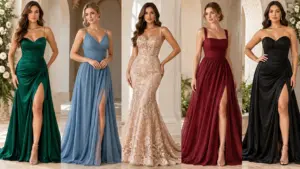
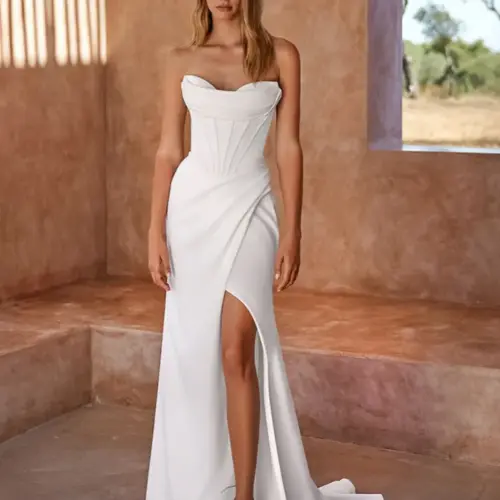
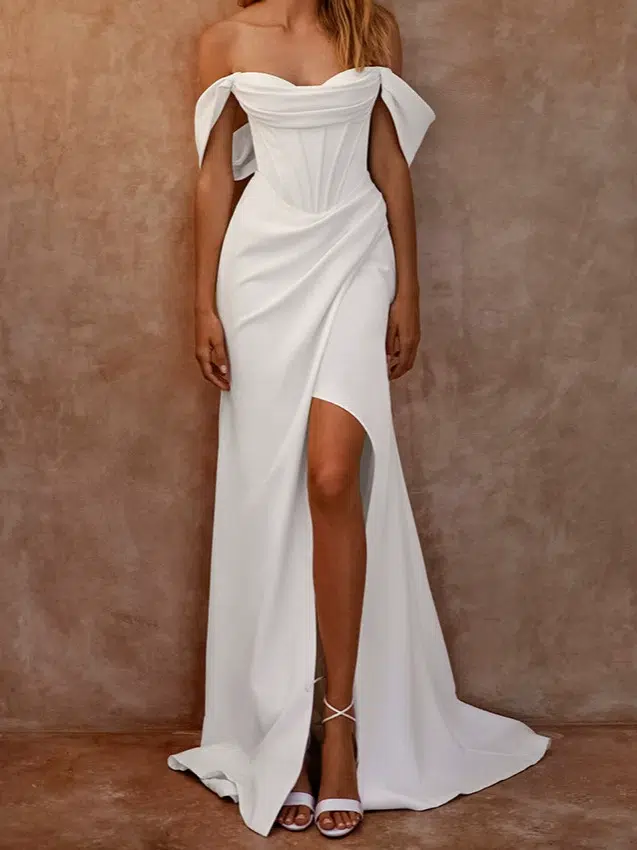
Formelle signifie généralement élégante et soignée, mais pas forcément au point de porter un smoking. Pour la plupart des événements modernes, une tenue formelle se traduit par un costume sombre et une cravate. hommes, et une robe longue ou une robe midi élégante pour femmes.

Le formel désigne un éventail de nuances, et non une seule uniformité.
Je considère le terme “ formel ” comme une gamme de nuances, car son usage varie selon les pays et les lieux. Je me souviens d'une cliente, Maria, originaire de Russie, qui m'avait demandé pourquoi la tenue “ formelle ” était perçue différemment à Londres et à Shanghai. Je lui avais expliqué que le mot restait le même, mais que le contexte changeait. Dans une salle de bal d'hôtel, on privilégie le smoking et la robe de soirée. Lors d'un mariage dans un vignoble, on opte plutôt pour un costume sombre et une robe longue, mais pas forcément le smoking. Je tiens également compte de l'heure. La tenue formelle de jour est généralement moins stricte que celle du soir. Pour un choix sûr, j'opte pour des couleurs classiques, sombres et épurées.
Liste rapide des vêtements de cérémonie
J'utilise le tableau ci-dessous lorsque je fais mes valises ou lorsque je conseille un client qui a besoin de vêtements habillés pour un voyage.
| étiquette de code vestimentaire | Hommes (tenue formelle masculine) | Femmes (femme en tenue de soirée) | Notes que je suis |
|---|---|---|---|
| Tenue formelle / Code vestimentaire formel | Costume sombre, chemise blanche ou claire, cravate | Robe longue, robe midi habillée, combinaison habillée | Évitez les imprimés voyants si l'événement est plutôt conservateur. |
| tenue de soirée formelle | Costume sombre, cravate, chaussures cirées | Robe longue, tissu raffiné, talons hauts habillés | Les tissus ont plus d'importance la nuit |
| Tenue de ville formelle pour hommes (style bureau) | Costume, cravate, chaussures en cuir fermées | Ensemble tailleur ou robe classique | C'est plus “ professionnel ” que “ mariage ”.” |
De petits détails qui donnent une allure élégante aux tenues habillées.
Je privilégie la coupe et la qualité du tissu. Je choisis une veste aux épaules bien droites et un pantalon qui ne fait pas de plis au niveau des chaussures. J'évite les tissus brillants et bon marché. Je choisis des accessoires sobres. Si je porte une tenue formelle entièrement noire, je veille à l'harmonie des nuances de noir. J'ajoute également une touche de texture, comme un revers en satin sur une robe ou une pochette impeccable sur un tailleur. Je n'en fais pas trop. Je privilégie la sobriété. Cette sobriété est synonyme d'élégance formelle dans presque toutes les situations.
Qu’est-ce qui est considéré comme une tenue de soirée pour les hommes et les femmes ?
J'ai vu des gens prendre le port du smoking à la légère, comme s'il suffisait de porter du noir. Cette erreur est flagrante sur les photos. L'hôte exigeait un certain niveau de tenue, et l'assistance s'y attendait.
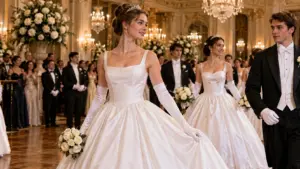
Le smoking est un code vestimentaire spécifique pour les soirées. Les hommes portent généralement un smoking avec un nœud papillon, et les femmes une robe longue ou une tenue de soirée très élégante.
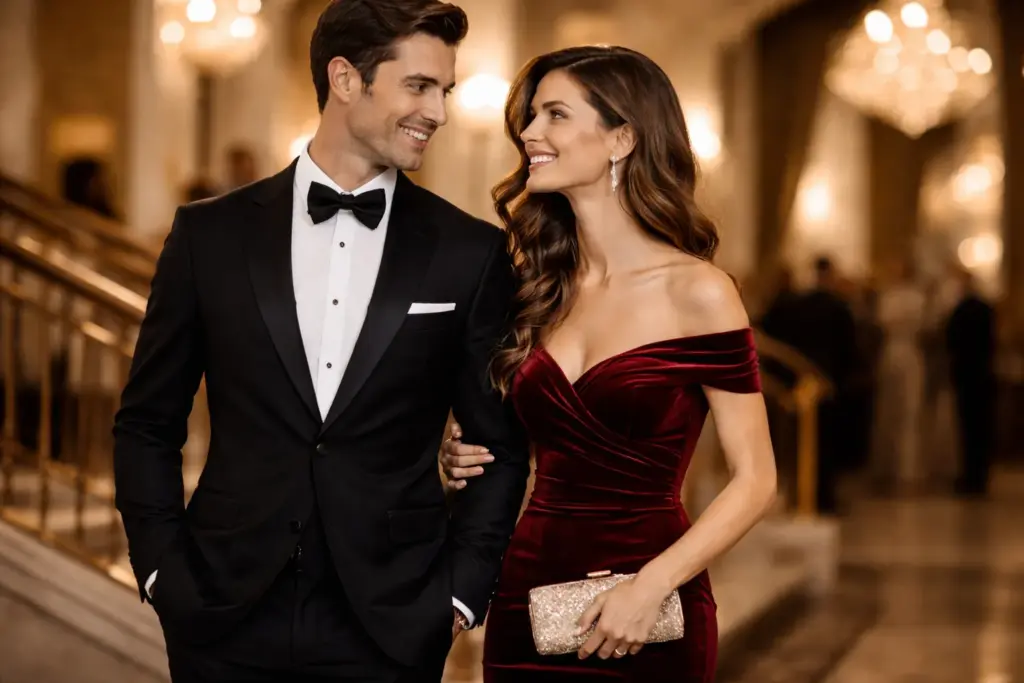
Le smoking est un uniforme, donc je respecte l'uniforme.
Quand je vois “ événement en tenue de soirée ” ou “ soirée de gala ” sur une invitation, je ne pense plus à composer une tenue, mais plutôt à respecter un code vestimentaire. Ce code existe car il assure une harmonie visuelle et des photos impeccables. Ayant fourni des vêtements de cérémonie à des marques organisant des galas, j'ai constaté que les tenues de soirée les plus sobres sont toujours les plus appréciées. On se souvient de la personne, pas des artifices vestimentaires.
Cravate noire pour hommes
J'utilise ces règles lorsqu'on me demande : “ Qu'est-ce qu'une tenue de soirée pour hommes ? ”
- Je choisis un smoking, pas un costume d'affaires classique.
- Je choisis un nœud papillon noir, et non une cravate longue, sauf indication contraire de l'hôte.
- Je choisis une chemise blanche, souvent à plastron formel.
- Je choisis des chaussures de soirée noires qui font très bel effet sous les projecteurs d'une salle de bal.
Cravate noire pour femmes
Quand on me demande ce qu'est une tenue de soirée pour une femme, je reste pragmatique. Je pense d'abord à la liberté de mouvement, puis à la formalité.
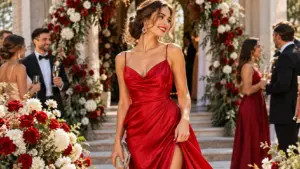
- J'ai choisi une robe longue jusqu'au sol, l'option la plus sûre.
- Je choisis un tissu raffiné comme le satin, le crêpe, le velours ou une dentelle structurée.
- Je choisis des talons hauts habillés ou des chaussures plates élégantes qui restent néanmoins adaptées à une soirée.
- J'évite le coton décontracté et les imprimés décontractés de jour.
Les règles du smoking dans une seule table
C'est cette table que j'aimerais voir figurer sur chaque invitation.
| Objet | Tenue de soirée (hommes) | Code vestimentaire cravate noire pour les femmes | Ce que j'évite |
|---|---|---|---|
| Pièce maîtresse | Smoking | robe longue ou robe de soirée très formelle | tailleurs de jour, robes décontractées |
| Cravate | Nœud papillon noir | Non requis | Cravates fantaisie colorées |
| Couleurs | Le noir est la couleur par défaut. | Couleurs sombres, profondes, noires, métalliques | Blocage de couleurs très décontracté |
| Accessoires | Ceinture ou gilet facultatif | Pochette, bijoux, châle de cérémonie | Grands sacs fourre-tout de jour |
L’expression “ tenue noire ” ne signifie pas toujours “ smoking ”.”
Certaines invitations mentionnent “ tenue de soirée en noir ” ou “ tenue noire ”. Je considère cela comme un thème de couleur, et non comme un code vestimentaire. Un thème de couleur peut s'adapter à différents niveaux de formalité. Le smoking reste obligatoire, sauf si l'invitation précise clairement “ tenue noire ”. Si l'invitation précise “ signification de la tenue de soirée ” ou “ signification du code vestimentaire smoking ”, je m'y conforme. Si l'invitation indique simplement “ porter du noir ”, je tiens compte du type d'événement. Un anniversaire en club est différent d'un gala de charité.
Comment choisir entre tenue formelle, tenue de soirée facultative et tenue de soirée obligatoire pour les mariages et les galas ?
J'ai vu des invités payer trop cher car ils pensent que tout mariage formel exige le port d'un smoking. J'ai aussi vu des invités sous-habillés se sentir mal à l'aise lors d'un mariage où le smoking est de rigueur.
Si l'invitation précise « tenue formelle », je porte par défaut un tailleur sombre ou une robe longue. Si elle précise « cravate noire », je porte par défaut un smoking et une robe de soirée. Si elle précise « cravate noire facultative », je considère qu'il s'agit d'une tenue formelle plus élaborée et je me base sur le lieu et l'heure pour choisir.

Étape 1 : Je lis les mots exacts, puis j’examine le contexte.
Les mots ont leur importance, mais le contexte aussi. Je tiens compte de quatre éléments : le lieu, l’heure, le style vestimentaire des mariés ou des hôtes, et le pays. Une soirée de gala dans un musée à 19 h suggère souvent une tenue de soirée, même si l’invitation mentionne “ tenue formelle ”. Un mariage dans un complexe hôtelier en bord de mer à 16 h est également souvent synonyme de tenue formelle, même si l’on parle de “ tenue de soirée ” de façon informelle. Je suis aussi attentive aux indices tels que “ gala ”, “ salle de bal ”, “ événement caritatif ” ou “ après 17 h ”. En cas de doute persistant, j’opte pour la solution la plus sûre. Dans la plupart des cas, il est préférable de s’habiller un peu plus élégamment, tout en conservant une allure classique.
Étape 2 : J’utilise une table de décision simple
Ce tableau m'aide à prendre des décisions rapidement, surtout lorsque je conseille des clients qui vendent sur différents marchés.
| Texte d'invitation | Mon par défaut (hommes) | Mon par défaut (femmes) | Ma petite note |
|---|---|---|---|
| La différence entre tenue de soirée et smoking n'est pas claire. | Costume sombre, cravate | Robe longue ou robe midi habillée | Je choisis des couleurs plus foncées et des tissus de meilleure qualité. |
| Soirée de gala | smoking, nœud papillon | robe longue | Je reste fidèle à la tradition |
| Cravate noire facultative | Costume sombre ou smoking | Robe longue ou robe midi très habillée | Je m'adapte au niveau de la pièce |
| Qu'est-ce qu'une cérémonie de mariage formelle ? | Costume sombre, cravate | Robe longue, tissu raffiné | J'évite les cocktails courts si l'ambiance est plutôt classique. |
Étape 3 : Je privilégie le confort, car le confort préserve l’aspect “ formel ”.”
Une tenue rigide est présentable pendant dix minutes. Une tenue confortable, en revanche, l'est pendant cinq heures. J'ai appris cela lors de salons professionnels et de banquets, où je devais rester debout à discuter longuement avec les acheteurs. Je privilégie les doublures respirantes, une veste qui me permet de lever les bras et des chaussures confortables. Aux femmes, je recommande une robe qui ne les oblige pas à faire de petits pas. Aux hommes, je suggère un pantalon bien coupé à la taille. Le confort réduit aussi l'agitation. Moins on gigote, plus on est sûr de soi, et la confiance est toujours synonyme d'élégance.“
Étape 4 : J'évite les erreurs les plus courantes
Je garde en tête une courte liste de “ choses à ne pas faire ” :
- Je ne considère pas la question “ tenue de soirée = smoking ” comme une réponse affirmative par défaut. Cela dépend de l'événement.
- Je ne porte pas de costume d'affaires à une soirée où le smoking est de rigueur, sauf si je sais que l'hôte l'accepte.
- Je ne considère pas qu'un costume noir et une cravate soient synonymes de smoking. Un smoking comporte des détails différents.
- Je ne choisis pas de tissus brillants bon marché. Ils font trop voyants sur les photos avec flash.
- Je n'oublie pas l'apparence. Une tenue formelle met l'accent sur les cheveux, les ongles et les vêtements repassés.
Conclusion
Le niveau de formalité est flexible, mais le smoking est une norme stricte pour les soirées. Lorsque ma tenue est en harmonie avec le contexte, le lieu et l'heure, je me sens bien et serein.
Pourquoi j’écris ceci
Je suis Lancy Chia de Truekung en Chine. Je dirige une usine de confection en gros employant plus de 200 personnes. Je propose des vêtements tendance et des services OEM/ODM. J'exporte vers des marchés comme le Royaume-Uni, les États-Unis, l'Allemagne et la Russie. Pour toute question concernant la production de vêtements de cérémonie ou de smokings, vous pouvez me contacter par courriel à l'adresse [email protected] ou consulter le site web truekung.com.
Vues : 1251