DTF looks simple on paper, but the wrong meaning can waste money and time. I have seen buyers order the wrong setup, then miss a selling season.
DTF means “Direct-to-Film.” In printing, it is a transfer method where I print a design on a special film, add hot-melt powder, cure it, then heat-press it onto fabric.

I still remember the first time a buyer asked me “what does DTF mean in printing?” and then, one minute later, asked “what does DTF stand for in slang?” That gap causes real problems in business talks, so I always start with clear words and clear samples.
What Does DTF Stand For in Printing?
DTF gets mixed with other meanings, so people talk past each other. I have seen emails that look polite, but they hide a big mistake.
DTF stands for “Direct-to-Film.” The DTF definition in printing is a method that prints a design on film first, then transfers it to a garment with heat and pressure.

DTF full form and the real DTF meaning
When someone types “what does dtf mean” or “dtf meaning,” they often want one clean answer. I give it like this: the dtf acronym in my factory talk is Direct-to-Film. That is the dtf full form that matters for shirts, hoodies, jackets, and bags. I also warn buyers that “DTF” can mean other things online, like slang. In business, I keep it professional. I write “Direct-to-Film (DTF) transfer printing” in the first line of the quote, and I add a photo of the film and a pressed sample. That stops confusion fast. When Maria, a strong Russian buyer, leads the call, she moves fast. So I match her speed with a simple definition, a process photo, and a spec sheet. That is how I reduce back-and-forth. I also explain that “DTF printing meaning” is not the same as DTG or screen printing. It is a transfer workflow. That detail matters for lead time, storage, and quality checks.
| Term buyers search | What I answer in one line | Why it matters |
|---|---|---|
| what does dtf stand for | Direct-to-Film | Stops wrong orders |
| dtf meaning printing | Film transfer method | Sets correct expectations |
| dtf prints meaning | Finished heat transfer print | Helps QC planning |
| define dtf | Print on film, press to fabric | Makes the method clear |
How Does Direct-to-Film Printing Work Step by Step?
People think DTF is “just print and press.” Then they get cracks, glue marks, or dull colors. That is painful when a season is close.
DTF printing works by printing a mirrored design on PET film, applying hot-melt powder, curing the powder, then heat-pressing the film onto the garment, and peeling it at the right time.

The DTF process from design to shirt
I break the dtf process into steps so a buyer can check each point. First, I prepare the dtf design. I confirm size, placement, and color profile. Second, I print the artwork onto film with DTF inks. The white layer matters, since it controls opacity on dark fabric. Third, I apply dtf powder, which is the hot-melt adhesive. The powder must cover the wet ink evenly, but it must not pile up. Fourth, I cure the powder with heat so it melts into a smooth layer. Fifth, I heat press the film onto the garment using set temperature, time, and pressure. Sixth, I peel the film. Some films are cold peel and some are hot peel, so the timing changes. Last, I often do a second quick press with a sheet to improve feel and durability. When Maria asks “what are dtf prints” or “what is a dtf print,” I show her the film stage and the final pressed stage. She cares about repeatability, so I record settings and share wash-test notes.
| Step | What can go wrong | What I check |
|---|---|---|
| Printing | banding, weak white | nozzle test, white density |
| Powder | bare spots, clumps | even coverage, clean edges |
| Curing | under-melt, over-bake | smooth glue layer, no yellowing |
| Pressing | lift, scorch, shine | correct pressure, correct sheet |
| Peeling | edge tears, ghosting | right peel type and timing |
What Makes DTF Different From Screen Printing and DTG?
Many buyers pick a method based on price alone. Then they get stuck with limits on fabric, colors, or minimum order.
DTF is a transfer method that works on many fabrics and supports full color with small quantities, while screen printing is best for large runs and DTG is best for direct printing on cotton with careful pretreatment.

Direct to film vs screen printing in real orders
I often get the keyword question “direct to film vs screen printing.” I answer with real order logic. Screen printing is strong when the design is simple and the quantity is big, because setup costs spread out. DTG is strong for soft hand feel on cotton, but it needs good pretreat and it can struggle on some blends. DTF sits in the middle. It handles small runs and many colors, and it can work on cotton, poly, and blends. That helps buyers who sell many styles in small batches. It also helps when a buyer wants to test a market. I tell Maria that DTF can reduce risk when she wants to launch a new line with 50 to 200 pieces per style. But I also tell her that DTF has a “transfer feel.” Some customers like it. Some want it thinner. So I suggest a sample set with different films and powders. That is the fastest way to match her brand position and her price point.
| Method | Best for | Weak point | Typical use in my factory talks |
|---|---|---|---|
| DTF | small to mid runs, full color | transfer feel if not optimized | fashion tees, hoodies, sportswear |
| Screen printing | large runs, simple colors | setup time and screens | promo tees, big events, uniforms |
| DTG | photo prints on cotton | pretreat needs skill | boutique drops, soft-feel prints |
What Should Buyers Check When Ordering DTF Printing on Shirts?
A nice photo is not proof. I have seen buyers accept a sample, then receive bulk that feels different. That creates returns and stress.
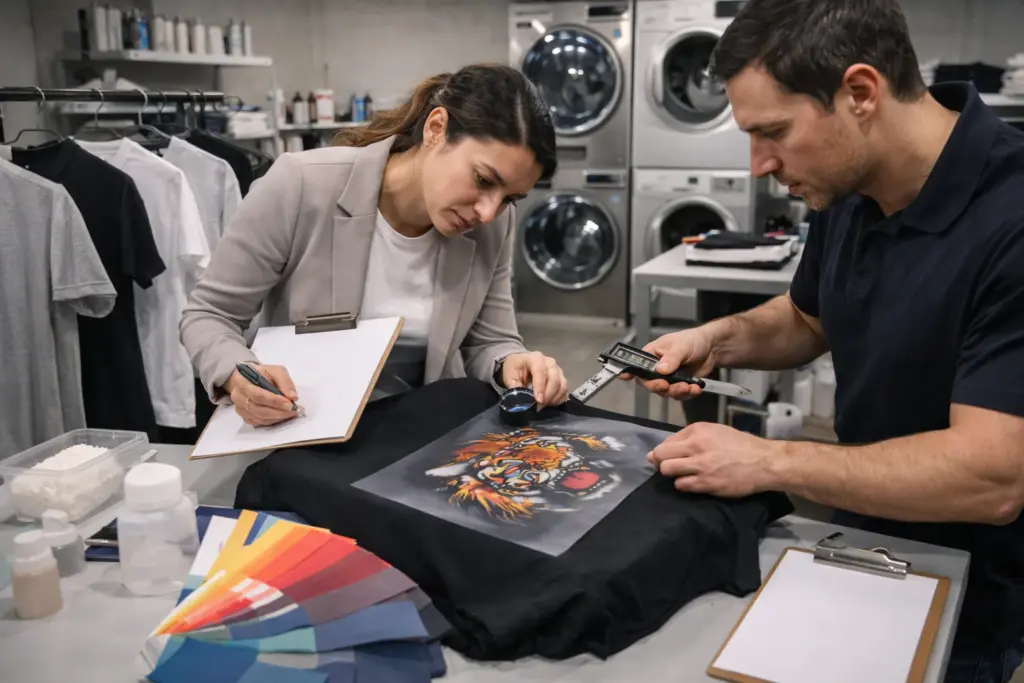
For DTF on shirts, I check film type, powder grade, press settings, wash test results, color consistency, and supplier process control, because these decide durability and feel.
A practical QC checklist for Maria-style buyers
Maria is sensitive to quality, and she also wants competitive prices. So I focus on checks that protect her brand and her margin. First, I ask what fabric she will use, since DTF adhesion can change across cotton, poly, and blends. Second, I confirm the target hand feel. Some brands want a thicker bold print. Some want it thin. That guides powder choice and press settings. Third, I run wash tests. I do at least a few cycles and I look for edge lifting, cracking, and color fading. Fourth, I check stretch recovery on rib and on activewear, since DTF can fail if the glue is wrong. Fifth, I confirm packaging and storage. DTF transfers can absorb moisture if packed badly. That can cause poor pressing later. Sixth, I set a clear approval method for bulk, like a golden sample and a press parameter sheet. This also helps when the buyer uses different heat press machines in different locations. That is common when they have several small workshops.
| Check point | What I measure | Pass sign |
|---|---|---|
| Wash durability | after wash cycles | no edge lift, no cracks |
| Stretch | pull and release | print returns, no split lines |
| Color match | compare to target | stable shades, stable black |
| Feel | hand touch test | matches brand level |
| Press window | time/temp/pressure | works across normal variance |
What Equipment and Materials Do I Need for DTF Transfers?
Many people think a “dtf printer meaning” is only the printer. Then they miss the real cost drivers, like curing and powder control.
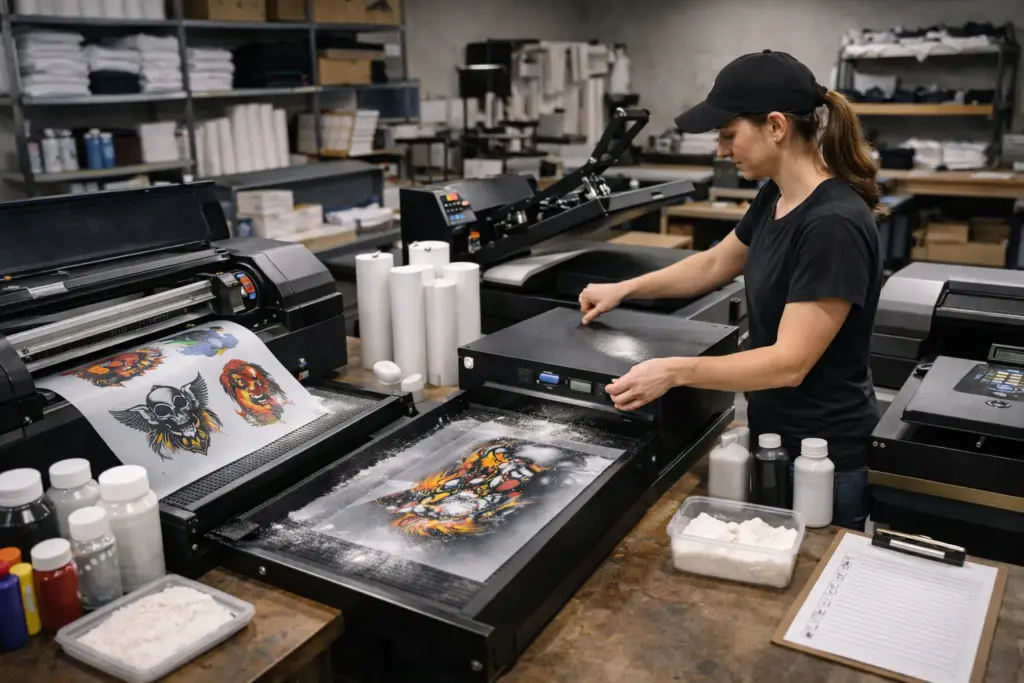
To make DTF transfers, I need a DTF printer, DTF inks, PET film, hot-melt DTF powder, a curing solution (oven or shaker/dryer), and a heat press with stable pressure and temperature.
Picking a setup that matches a business model
When someone searches “whats a dtf printer” or “printer for heat press machine,” they are often building a small workshop. I explain the system as a chain. The printer lays ink. The film holds it. The powder bonds it. The cure melts it. The heat press finishes it. If one link is weak, the final shirt fails. For a B2B wholesale buyer, the goal is stable output, not just low entry cost. So I focus on maintenance and repeatability. A stable heat press with even pressure matters a lot. Uneven pressure can cause partial adhesion, and the print can lift at the edges. I also talk about ventilation and powder handling, since messy powder creates defects and waste. For factory work, I like a shaker and dryer line when volume grows, since it reduces labor and improves consistency. For small tests, a simple cure oven can work, but the operator must control temperature well. I also tell buyers to plan for consumables, like cleaning solutions, spare dampers, and extra film. Those small items decide uptime.
| Item | Why I care | Buyer question it answers |
|---|---|---|
| Printer + inks | color and white opacity | dtf printing meaning in output |
| Film | peel type and clarity | what are dtf prints |
| Powder | adhesion and feel | what is dtf powder |
| Curing | stability and speed | dtf process reliability |
| Heat press | final bonding | what does dtf printing mean |
Conclusion
DTF means Direct-to-Film in printing, and it gives flexible, full-color transfers for many fabrics, but only if I control process, materials, and testing.
Why I Write This
I am Lancy Chia from Truekung in China. I run B2B wholesale production with OEM/ODM support, and my factory has over 200 workers. I produce fashion apparel and related items, and I help brands manage quality control, delivery, and clear communication. If you want to talk about DTF printing on shirts, transfers, or bulk apparel production, you can reach me at [email protected], and you can also find more at https://truekung.com.
Views: 212