Cotton and viscose often look the same on the rack, and that confusion can cost me in returns, claims, and wasted sampling time. I need a fast check that works even when labels are missing.
The quickest way is a simple “water + feel” check: cotton usually feels drier and slightly grainy, while viscose feels cooler, smoother, and gets limp faster when damp. Combine that with a quick wrinkle test and a burn test (only when safe) to confirm within minutes.

I learned this the hard way. A buyer once told me a “cotton dress” felt too slippery and collapsed after steaming. That one comment pushed me to build a short checklist that I can use in a meeting room, not only in a lab.
Can I tell cotton and viscose apart just by touch and drape?
Cotton and viscose can both be soft, and both can be woven or knitted, so I can get tricked if I only rely on one feeling. I still need a quick method that I can repeat every time.
Yes, I can often tell by touch and drape: cotton tends to feel more dry and structured, while viscose tends to feel cooler, smoother, and more fluid, with a heavier “hang” for the same thickness.
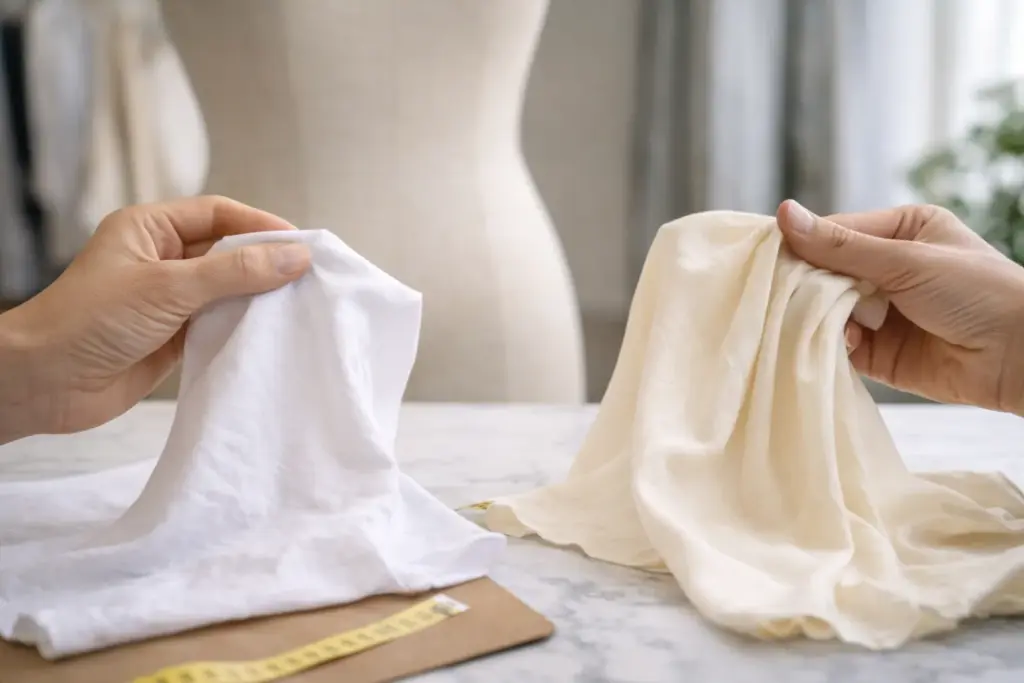
When I do the touch-and-drape check, I use three small actions. I rub the fabric lightly between my fingers, I let it fall from my hand, and I press it into a loose ball for two seconds. Cotton usually gives me a small “paper-like” grip. It feels a bit more matte. It also resists collapsing. Even when it is soft, it keeps some body. Viscose often feels more slick, even when it is not shiny. It also feels cooler at first touch. The drape is the bigger clue for me. Viscose falls in longer, rounder folds, like it wants to flow. Cotton often breaks into shorter folds, like it wants to hold shape.
Quick feel-and-drape cues I use
| Check | Cotton (typical) | Viscose (typical) | What I do in 5 seconds |
|---|---|---|---|
| First touch | Drier, slightly grainy | Cooler, smoother | Touch with the back of my fingers |
| Surface look | More matte | Can look slightly “liquid” | Tilt under light, watch the reflection |
| Drape | Holds shape more | Hangs more fluid | Hold one corner and let it fall |
| “Grip” when rubbing | More grip | More slip | Rub lightly between thumb and index finger |
I do not treat this as proof. I treat it as my first filter. If I am buying in bulk or I am doing OEM/ODM, I always combine this with at least one more test.
Does the wrinkle test work as a fast check?
Some fabrics wrinkle for many reasons, so I cannot assume wrinkles always mean cotton. Still, I need something fast that a buyer like Maria can also do without tools.
Yes, the wrinkle test helps: cotton usually wrinkles with sharper creases and holds them, while viscose wrinkles into softer, more rounded lines and can look “crushed” or limp after squeezing, then relaxes a bit when hung.

I use the wrinkle test because it is simple and it helps in real sourcing settings. I pinch a section about the size of my palm, then I squeeze it into a ball for three seconds. After that, I open my hand and lay the fabric flat. Cotton often shows clear crease lines, and those lines stay visible. The creases look more “edge-like.” Viscose can wrinkle a lot too, but it often shows a crushed look, with many soft lines. It can also lose its shape quickly. In some blends, viscose can spring back more than I expect, so I focus on the shape after the squeeze. Cotton often keeps some firmness. Viscose often looks tired, like it wants to hang down.
How I interpret wrinkles with common fabric structures
| Fabric type | Cotton reaction | Viscose reaction | My note |
|---|---|---|---|
| Plain woven | Sharp creases | Softer creases, more collapse | Best for quick comparison |
| Twill | Creases but less sharp | Creases with a “wave” look | Twill can hide wrinkles |
| Jersey knit | Less obvious creases | Can look stretched and limp | Knit needs the water test too |
| Satin weave | Can still crease | Can look very “liquid” and crush | Shiny weaves can confuse me |
If a buyer is very sensitive to quality, I tell them this: wrinkles alone do not mean low quality. They only tell me how the fiber and structure behave. That keeps the conversation calm and clear.
Can the water drop test confirm the fiber quickly?
Sometimes I do not have time for lab tests, and I cannot always do a burn test in a showroom. I need a low-risk method.
Yes, a small water drop test is fast: cotton usually absorbs water and darkens in a tight spot, while viscose also absorbs fast but often spreads and makes the fabric feel limp and clingy, with a cooler wet touch.

I carry a small dropper bottle when I travel for sourcing. I only use one or two drops, and I test a seam allowance or an inside area. Cotton often drinks water straight in, but the wet spot can stay more “local.” The fabric keeps some shape. Viscose can absorb fast too, but it often spreads in a wider area, and the fabric can lose structure quickly. It can also feel slick and clingy when damp. That limp feeling is a strong clue for me. When I lift a damp viscose corner, it can stretch and droop more. Cotton can also droop when it is thin, but it still feels more stable.
Water test checklist I follow
| Step | What I do | What cotton often shows | What viscose often shows |
|---|---|---|---|
| 1 | Add 1–2 drops | Tight dark spot | Dark spot that can spread |
| 2 | Wait 10 seconds | Feels damp but stable | Feels damp and limp faster |
| 3 | Rub the wet area | More friction | More slip and cling |
| 4 | Hang the corner | Holds shape more | Drape increases, looks heavier |
This test is not perfect for heavy finishes, coatings, or dense weaves. A water-repellent finish can break it. If the fabric is treated, I move to label checks or a small sample sent for testing.
Is the burn test a reliable last step for cotton vs viscose?
I work with factories, but I also meet buyers in offices and hotels. Fire is not always allowed, and safety matters more than speed. Still, I want a reliable backup when I can do it safely.
Yes, the burn test can be reliable: both cotton and viscose are cellulose fibers, so both burn like paper, but cotton often leaves a softer, fluffier ash, while viscose can leave a finer, more fragile ash and may burn faster if the fabric is very light.

I treat the burn test as a last step, not the first. I only do it in a safe area, with a metal tray, water nearby, and only with a tiny yarn or edge thread. I also confirm local rules. Since both fibers are cellulose-based, they can look similar in flame behavior. That is why I focus on the residue and the burn speed, not only the smell. Cotton often burns steadily and leaves a soft grey ash that crushes easily. Viscose can burn very quickly, and the ash can look more powder-like and fragile. If there is any synthetic blend, I will see melting or hard beads, and that tells me I should stop guessing and ask for the exact composition.
Burn test signals I record
| Signal | Cotton (common) | Viscose (common) | Blend warning |
|---|---|---|---|
| Flame behavior | Steady, paper-like | Can flash faster | Melting edges or dripping |
| Smoke | Light | Light | Dark, sharp chemical smoke |
| Residue | Soft ash | Fine fragile ash | Hard bead or sticky residue |
| Smell | Burning paper | Burning paper | Plastic or chemical odor |
If I need high confidence for production, I do not rely on burn tests alone. I request a fiber test report or send the fabric to a third-party lab. For buyers like Maria, this is also about trust. Clear testing protects both sides.
Conclusion
I use touch and drape first, then a wrinkle or water test, and I keep burn testing as a safe last step, so I can avoid costly mistakes in cotton vs viscose sourcing.
Why I write this
I am Lancy Chia from Truekung in China. I run a wholesale clothing factory with 200+ workers, and I provide OEM/ODM for brands and supermarkets worldwide. If you need stable quality and clear fiber control, you can reach me at [email protected].
Views: 234