
Je vois sans cesse des acheteurs qualifier tout de “ fermeture éclair » hoodie,” Et puis ils reçoivent des échantillons qui se portent comme un manteau ou qui taillent comme une boîte. Cette erreur coûte cher en budget. ».
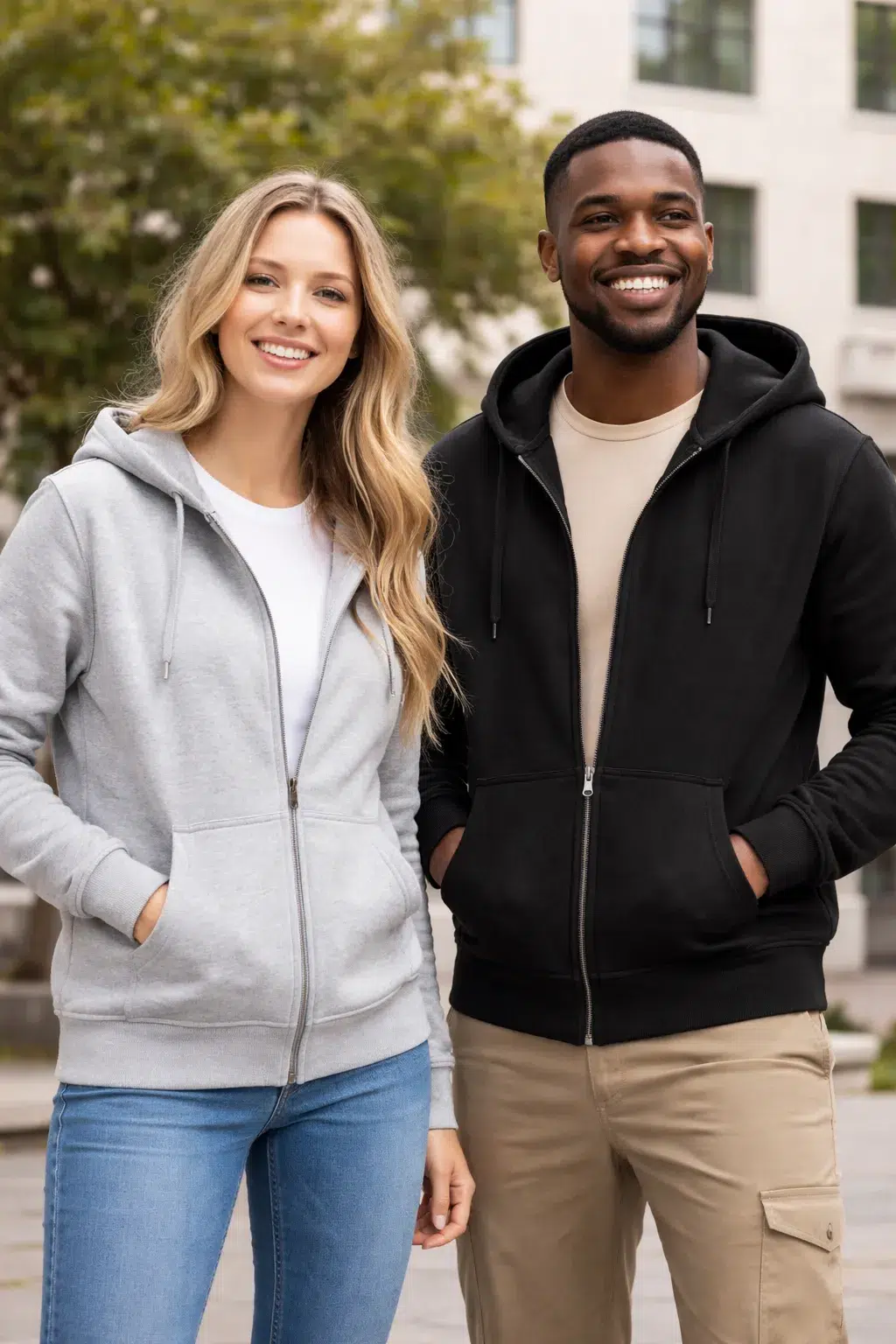
Je définis un sweat à capuche zippé comme un sweat-shirt à capuche avec une fermeture éclair sur toute la longueur du devant. fermeture éclair qui divise le devant en deux panneaux, je peux donc le porter fermé, semi-ouvert ou ouvert comme une veste légère.
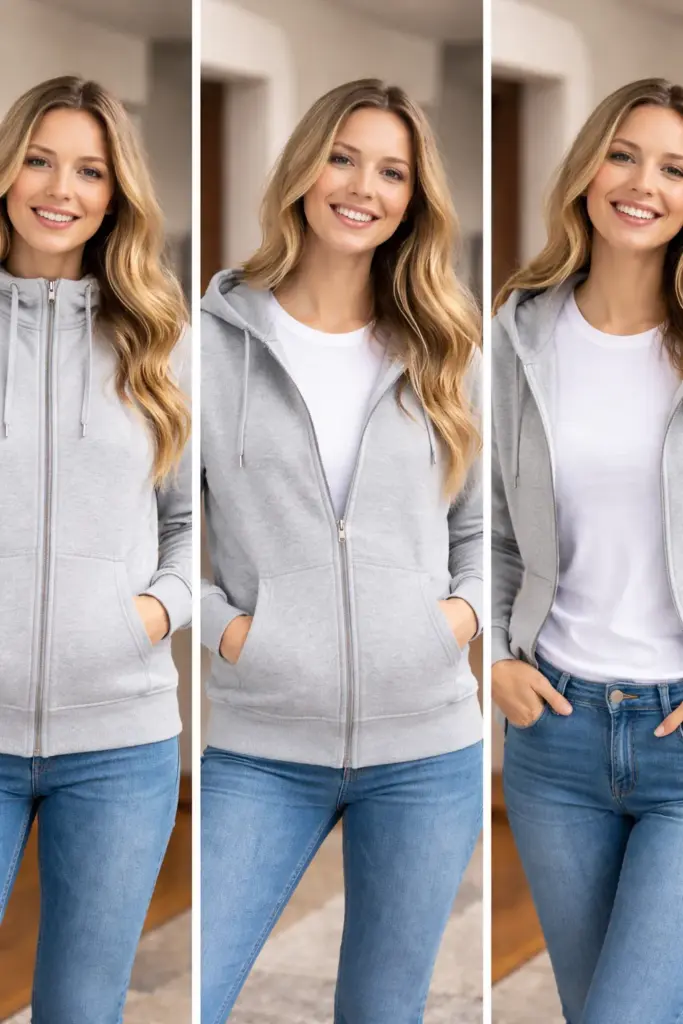
J'ai vite compris que “ décontracté ” n'est pas un terme de style. Je le vois plutôt comme un système avec des règles, et la fermeture éclair en est l'élément central. Je souhaite que vous compreniez ces règles de la même manière, afin que vous puissiez acheter et vendre avec plus d'assurance, et repérer les problèmes avant l'expédition.
Un sweat à capuche zippé est-il vraiment différent d'une veste zippée ?
Quand j'entends “ veste zippée ”, je reçois souvent un échantillon en tissu tissé avec doublure, et il est rigide. Je perds du temps à corriger la catégorie.
Je l'appelle un sweat à capuche zippé quand je pars d'un sweat-shirt et que j'y ajoute une fermeture éclair intégrale qui divise le devant en deux. Quand le vêtement ressemble à un pull décontracté, je ne l'appelle pas une veste.
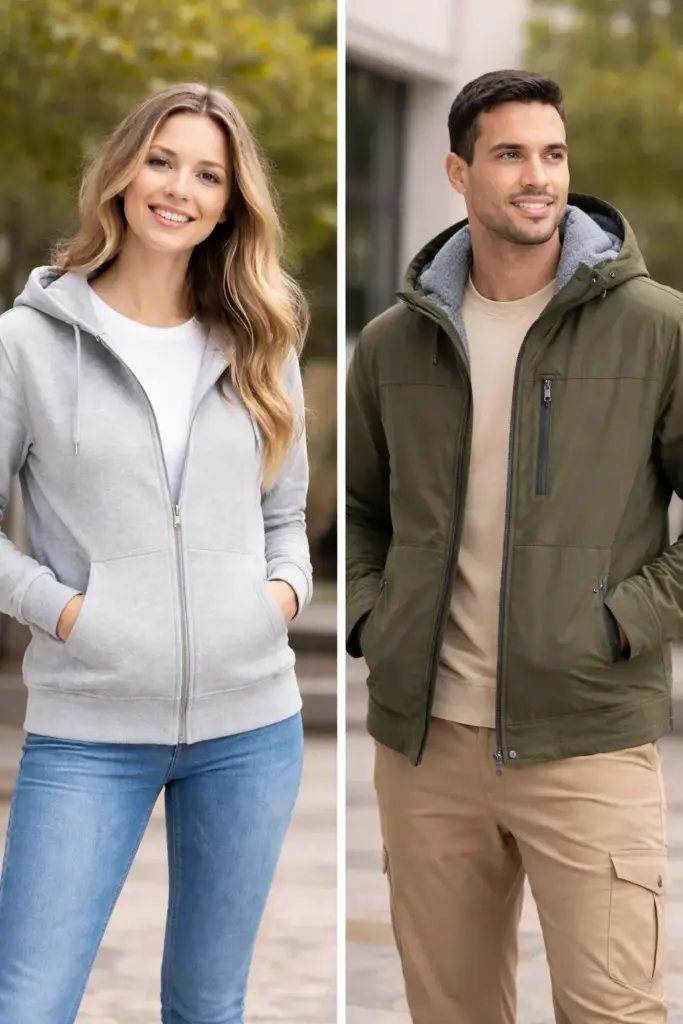
La ligne de catégorie que j'utilise
J'ai une règle simple en tête : je considère avant tout un sweat à capuche zippé comme un sweat à capuche, et la fermeture éclair comme l'élément qui change la façon dont je le porte. J'attends donc toujours la douceur du tricot, les poignets côtelés et le style décontracté d'un sweat-shirt. La fermeture éclair offre un meilleur contrôle : je peux aérer, superposer les vêtements et l'enlever sans avoir à le passer par la tête. Cela peut paraître anodin, mais cela change complètement la donne au quotidien.
Je vois aussi plusieurs appellations pour un même article. Certains acheteurs écrivent “ sweat à capuche zippé ”, d'autres “ sweat à capuche zippé ” ou encore “ sweat-shirt zippé ”. Je ne discute pas du nom. Je m'intéresse à la coupe et au tissu. Si la fermeture éclair s'ouvre entièrement du bas jusqu'au cou, je le considère comme un sweat à capuche zippé. Si elle s'arrête à la poitrine, je le considère comme un produit différent.
Lorsque Maria, une acheteuse russe, m'a demandé un lot de sweats à capuche zippés pour hommes, je n'ai pas commencé par les couleurs. J'ai commencé par une question : “ Préférez-vous la sensation d'un sweat ou celle d'une veste ? ” Elle a répondu qu'elle souhaitait la sensation d'un sweat, mais avec une coupe plus nette, comme un vêtement d'extérieur. Sa réponse m'a donc indiqué de rester dans les matières des sweats à capuche, mais de resserrer le motif et la finition de la fermeture éclair.
| Ce que je vois dans les demandes de renseignements | Ce que je pense que cela devrait signifier | Ce que je demande pour confirmer |
|---|---|---|
| Je vois “ sweat à capuche zippé ” ou “ sweats à capuche zippés ” | Je m'attends à un sweat à capuche avec une fermeture éclair intégrale. | Je demande le type de tricot, son épaisseur et la longueur de la fermeture éclair. |
| Je vois “ veste à fermeture éclair ” | Je m'attends à une gamme plus étendue, je vérifie donc s'il est tissé. | Je leur demande s'ils préfèrent une doublure, un tissu extérieur ou une maille molletonnée. |
| Je vois “ sweat-shirt à fermeture éclair ” | Je m'attends à un sweat-shirt avec une fermeture éclair sur le devant. | Je leur demande s'ils veulent toujours une capuche et une poche kangourou séparées. |
| Je vois “ sweat-shirt à fermeture éclair intégrale pour homme ” | Je m'attends à une qualité masculine et à des finitions plus épaisses. | Je demande les cibles pour le tour de poitrine, la longueur, la longueur des manches et la fourchette de tailles. |
| Je vois “ sweat à capuche noir à fermeture éclair intégrale ” | Je m'attends à une teinture nette, un rétrécissement stable et des fermetures éclair fluides. | Je demande les objectifs du test de lavage et les besoins en matière de tenue des couleurs. |
| Je vois “ pull-over des jumeaux MN ” | Je m'attends à un contrôle routier et à d'éventuelles restrictions de permis. | Je leur demande s'ils possèdent les droits et s'ils veulent un pull, pas un modèle à fermeture éclair. |
Pourquoi le système de fermeture éclair est-il plus important que le logo ?
Je peux pardonner un logo basique, mais pas une fermeture éclair qui flotte, coince ou se casse. Une seule fermeture éclair défectueuse gâche tout le sweat à capuche.
J'évalue un sweat à capuche zippé en fonction du fonctionnement et de la position de la fermeture éclair : elle doit glisser facilement, être bien à plat et maintenir le devant du vêtement stable. Si je ne peux pas l'ouvrir et la fermer rapidement d'une seule main, je ne l'approuve pas.
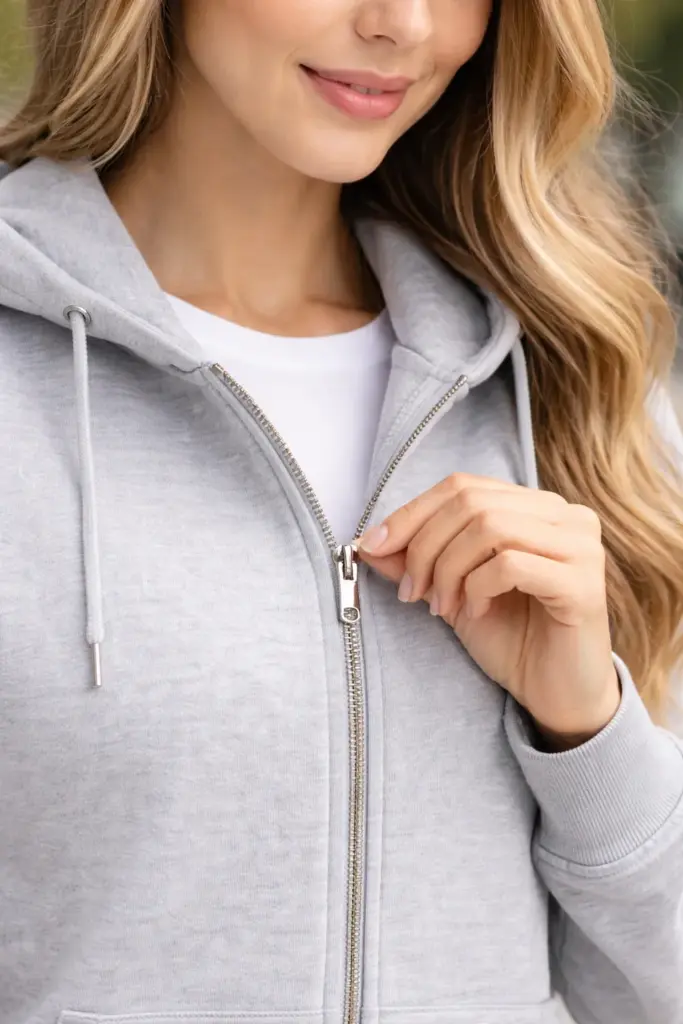
L'anatomie de la fermeture éclair que je vérifie
Je démonte la fermeture éclair car chaque pièce présente des signes de défaillance différents. Je commence par examiner le type de dents, la bande et le curseur. Si le curseur est lâche, il peut vibrer et user les dents. Si la bande est fine, elle peut se détendre et créer des ondulations sur le devant. Si la butée inférieure est fragile, elle peut céder après quelques tractions brusques. Je n'ai pas besoin d'une fermeture éclair de luxe pour chaque utilisation. prix j'ai besoin d'un niveau stable pour chaque niveau.
La couture et les finitions que je surveille
Je surveille davantage la couture de la fermeture éclair que celle de la capuche. Un sweat à capuche peut supporter une capuche légèrement de travers, mais pas une fermeture éclair qui ondule au milieu. J'observe comment l'usine stabilise l'ouverture avant et l'équilibre des surpiqûres. Si l'opérateur tire plus d'un côté, le vêtement se tord. Si la marge de couture varie, la fermeture éclair prend un aspect ondulé.
Je me souviens d'une production en série où l'échantillon était parfait, mais les pièces finales présentaient une légère courbure en “ S ” au niveau de la fermeture éclair. L'usine n'a pas modifié la fermeture éclair. Elle a simplement changé la vitesse de couture et omis l'étape de la pose d'une petite bande stabilisatrice. Ce petit raccourci a engendré un risque important de retour. Depuis, je détaille les étapes de couture des fermetures éclair dans la fiche de production et j'exige un contrôle en cours de fabrication, axé uniquement sur la planéité de la fermeture éclair.
| Ce qui se passe mal en conditions réelles d'utilisation | Ce que je vérifie sur l'échantillon | Ce que je demande à l'usine d'ajuster |
|---|---|---|
| J'ai une sensation de blocage quand je ferme la fermeture éclair. | Je teste la tension du curseur et la régularité du ruban. | Je modifie les spécifications du curseur ou la finition du ruban. |
| Je vois une vague de fermeture éclair sur le devant | Je le pose à plat et je mesure la différence entre le panneau gauche et le panneau droit. | J'ajoute du ruban stabilisateur et je corrige la tension de la couture. |
| Je vois des plis près du haut | Je vérifie la courbe de l'encolure et la position du haut | J'ajuste l'encoche du patron et la profondeur de la fermeture éclair. |
| Je vois des dents écartées. | Je vérifie le type de dents et la distance des points de suture par rapport aux dents. | Je remplace légèrement la fermeture éclair ou je déplace légèrement la ligne de couture. |
| Je sens des bords tranchants de tire-fils | Je vérifie la forme et le plaquage de l'extracteur. | Je change le tire-menton et teste le confort au niveau du menton. |
Comment le poids du tissu et la coupe définissent-ils un sweat-shirt zippé moderne ?
Je vois souvent des acheteurs commander des sweats à fermeture éclair sans préciser le poids ni la coupe. Résultat : ils ont trop chaud, trop fin ou trop court.
Je définis un sweat-shirt zippé moderne par deux chiffres : le poids du tissu et les dimensions finales. Lorsque le poids est adapté au climat et la coupe à la clientèle cible, le sweat-shirt se vend systématiquement.
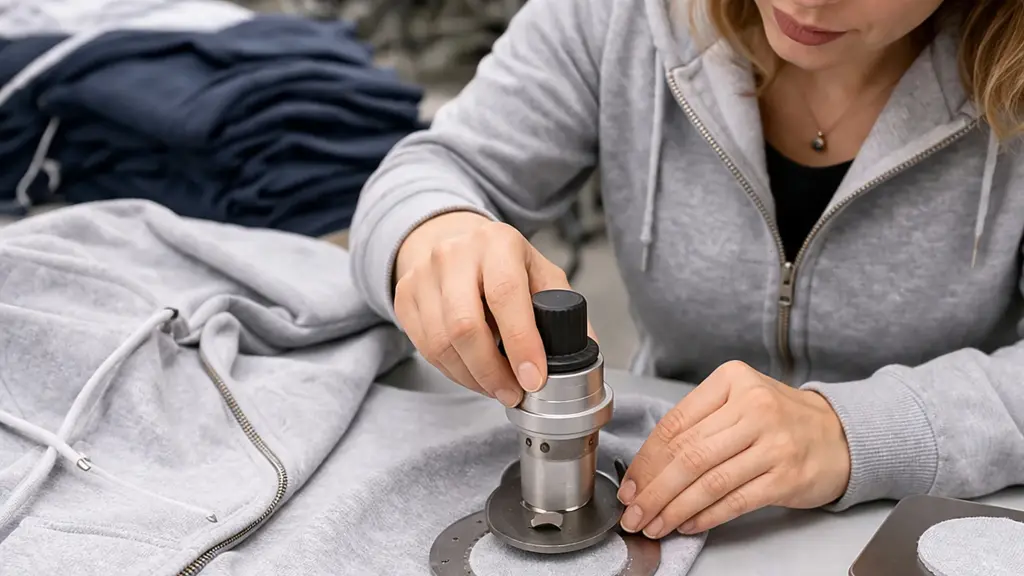
Les tissus que j'utilise le plus
Je travaille en Chine avec une équipe d'usine, ce qui me donne accès à un large choix de tissus que j'utilise comme des outils. Pour un sweat à capuche zippé classique, j'opte souvent pour une maille polaire quand je recherche chaleur et douceur. Je préfère le tissu éponge pour un intérieur plus propre et une sensation de légèreté. Je fais également attention au mélange de fibres, car il influe sur le rétrécissement et la tenue de la forme. Si je privilégie le coton, je prévois un système anti-rétrécissement et je fais un test de lavage. Si j'ajoute plus de polyester, je privilégie une meilleure élasticité et un séchage plus rapide, mais je surveille aussi le boulochage.
Les choix vestimentaires qui façonnent le “ moderne ”
Je ne pense pas que “ moderne ” rime systématiquement avec “ surdimensionné ”. Pour moi, “ moderne ” signifie plutôt « intentionnel ». Je définis la hauteur des épaules, l'aisance au niveau de la poitrine et la longueur du corps avec une raison bien précise. Lorsque je crée des vêtements pour hommes, je considère un « sweat à capuche zippé pour homme » comme une promesse de confort, et non comme une simple étiquette. Je vérifie la largeur des biceps pour un confort optimal et la tension des côtes à l'ourlet pour que le vêtement tombe parfaitement, même avec la fermeture éclair ouverte.
Je considère également la couleur comme un choix technique. Un sweat à capuche noir à fermeture éclair intégrale paraît simple, mais la teinture noire peut rapidement révéler des défauts. Je vérifie l'homogénéité de la teinte et m'assure que la couleur de la bande de la fermeture éclair reste la même après lavage. Si la bande se décolore rapidement, la ligne centrale paraît bon marché, même si le tissu du vêtement conserve sa belle couleur.
| Ce que je décide | Ce que j'ai défini en chiffres | Ce que cela change au quotidien |
|---|---|---|
| Je choisis un poids plus léger. | Je vise environ 240–300 GSM pour de nombreux climats | J'obtiens une superposition plus facile et moins d'épaisseur sous les couches. |
| Je choisis un poids moyen | Je vise un grammage d'environ 300 à 360 g/m² pour une utilisation polyvalente. | Je prends un sweat à capuche zippé équilibré pour les trajets domicile-travail et pour l'intérieur. |
| Je choisis les poids lourds | Je vise un grammage d'environ 360 à 450 g/m² pour obtenir une mise au point à froid. | J'ai l'impression qu'elle ressemble davantage à une veste, sans pour autant l'appeler une veste zippée. |
| J'ai choisi une coupe standard. | Je maintiens une aisance de poitrine contrôlée et une longueur constante | Je bénéficie de vêtements portés plusieurs fois par plus de personnes et de moins de retours. |
| J'ai choisi une coupe décontractée. | J'ajoute plus d'aisance et un corps légèrement plus long. | J'ai du volume dans le style streetwear, mais je fais attention au risque de vague de fermeture éclair. |
| Je choisis court ou court | Je raccourcis le corps et garde les manches proportionnelles. | Je suis les tendances en matière de formes, mais je planifie soigneusement les retours sur les tailles. |
Que doivent vérifier les acheteurs en gros avant de commander des sweats à capuche zippés ?
J'ai constaté que les retards de livraison et les faux documents nuisent à de bonnes marques. Je protège les acheteurs en transformant le “ sweat à capuche basique ” en une liste de critères claire.
Avant de parler de prix, je vérifie les caractéristiques des sweats à capuche zippés : je m’assure d’abord des spécifications techniques, je teste la fermeture éclair et je vérifie le processus de fabrication. Ainsi, j’évite les mauvaises surprises qui pourraient gâcher la saison.
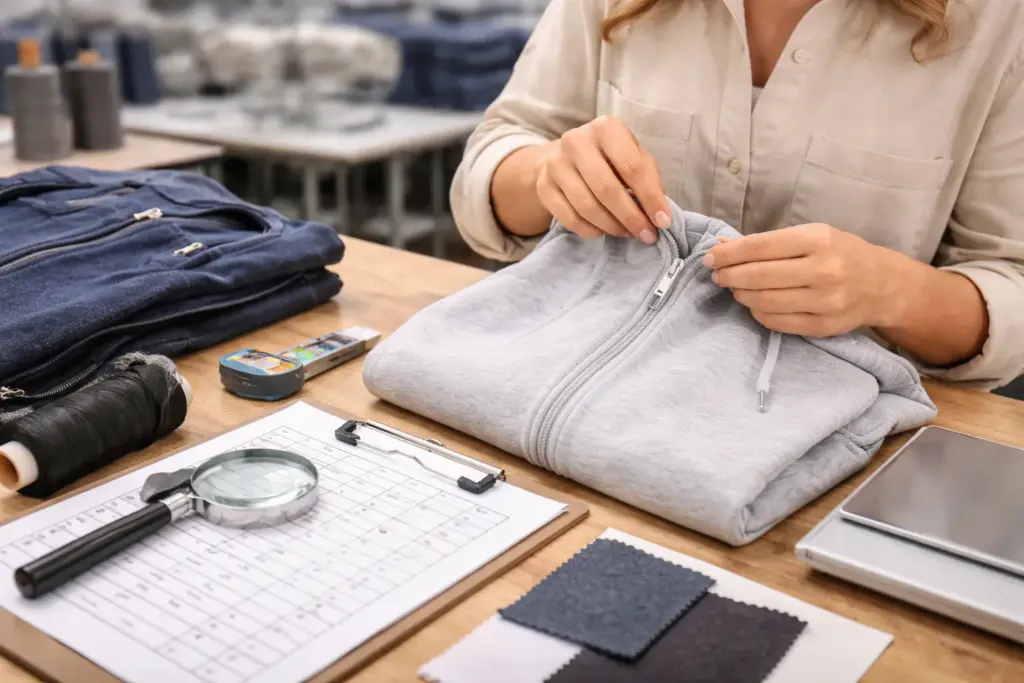
Le processus que je suis, de l'idée à la production en série
Je commence toujours par un dossier technique complet, même pour un modèle d'apparence simple. J'y indique le tissu, son poids, le rétrécissement maximal prévu, les caractéristiques de la fermeture éclair, la forme des poches, la profondeur de la capuche et la largeur des côtes. Ensuite, je demande un échantillon que je traite comme un outil de test, et non comme un simple accessoire photo. Je le lave, je le ferme rapidement avec la fermeture éclair et je le suspends pour vérifier si le devant se déforme. Si je constate un problème, je refuse d'accepter l'argument “ c'est normal ”. J'insiste pour obtenir une correction avant de fixer la taille.
Ensuite, je supervise les étapes de préproduction. Je demande un contrôle par lot de fermetures éclair et une vérification des dimensions. Je demande également à l'usine de figer la méthode de couture, car la fabrication des fermetures éclair est sensible aux habitudes des opérateurs. C'est ainsi que je protège Maria de son principal souci : les retards de livraison qui lui font perdre une saison. En résolvant les problèmes au plus tôt, je limite les retouches.
Je ne néglige jamais les contrôles qualité et de fiabilité.
Je vérifie systématiquement les documents. J'ai déjà vu des fournisseurs falsifier des certificats, ce qui peut nuire gravement à une marque. C'est pourquoi je demande des rapports de tests à des laboratoires reconnus lorsque le marché l'exige, et je vérifie que les détails du rapport correspondent bien au produit fini. J'établis également des normes de contrôle qualité strictes pour les coutures, les mesures et le fonctionnement des fermetures éclair, et je demande des photos de l'inspection finale ainsi que les données clés.
| Ce que je vérifie avant de payer le solde | Ce que je demande à voir | Ce que je protège en le faisant |
|---|---|---|
| Je confirme que le tissu en vrac correspond à l'échantillon. | J'évalue la quantité, le poids et la sensation au toucher. | J'évite les dérives de couleur et les rétrécissements inattendus. |
| Je confirme la qualité du lot de fermetures éclair | Je teste des pièces choisies au hasard pour vérifier la fluidité de la fermeture éclair et la mise à plat. | J'évite les retours et les plaintes concernant les fermetures éclair cassées. |
| Je confirme les mesures sur l'ensemble de tailles | Je compare à la fiche technique avec tolérance. | J'évite les débats sur la taille des sweats à fermeture éclair pour hommes. |
| Je confirme l'étiquetage et l'emballage | Je vérifie l'étiquette principale, l'étiquette d'entretien et les règles relatives au sachet plastique | J'évite les retards douaniers et les problèmes de conformité du commerce de détail. |
| Je confirme le calendrier de production | Je suis les dates de découpe, de couture, de finition et d'expédition | J'évite les périodes de vente manquées |
La réalité complexe des mots-clés que je constate dans les demandes réelles
J'observe aussi un détail amusant lors de l'approvisionnement : les acheteurs et les clients finaux font souvent des fautes d'orthographe, et l'équipe de production peut être désorientée si la demande n'est pas claire. C'est pourquoi je traduis les demandes en spécifications. Je ne laisse pas une faute de frappe impacter le produit.
| Ce que je vois tapé | Ce que je considère comme | Ce que j'écris dans les spécifications |
|---|---|---|
| Je vois “ sweat à capuche zippé ” ou “ sweat à capuche zippé homme ” | Je le considère comme un sweat à capuche zippé | Je verrouille la fermeture éclair sur toute sa longueur et le classement pour hommes |
| Je vois “ zip up hopdie ” ou “ zip up hooides ” | Je les considère comme des sweats à capuche zippés. | Je verrouille le corps du sweat à capuche, la forme de la capuche et les poches |
| Je vois “ sweat à capuche zippé ” ou “ sweat à capuche zippé ” | Je le considère comme un sweat à capuche zippé | Je fais des finitions en maille et en tissu à capuche, pas en doublure de veste. |
| Je vois “ sweat à capuche zippé ” | Je le considère comme un sweat à capuche zippé | Je confirme les spécifications de la fermeture éclair et la séparation du panneau. |
| Je vois “ sweat à capuche zippé ” | Je le considère comme un sweat à capuche zippé | J'ajoute des tests de fonctionnement des fermetures éclair au contrôle qualité. |
| Je vois “ pull-over des jumeaux MN ” | Je considère cela comme une demande de pullover | Je demande une preuve de licence et je confirme qu'il ne s'agit pas d'une fermeture éclair. |
Conclusion
Un sweat à capuche zippé est un vêtement composé d'une première couche de sweat-shirt et d'une fermeture éclair intégrale sur le devant. En maîtrisant la fermeture éclair, le tissu et la coupe, j'obtiens un confort durable et je réduis les risques de surcharge.
Pourquoi j’écris ceci
Je suis Lancy Chia, de Truekung en Chine. Je travaille exclusivement en gros avec une équipe de plus de 200 ouvriers. Je crée des vêtements tendance et propose des programmes OEM/ODM pour des marques et des supermarchés du monde entier. Pour moi, la fabrication de sweats à capuche est une affaire de stratégie, pas une simple supposition.
- Marque : Truekung
- Modèle d'entreprise : Commerce de gros B2B uniquement
- Ce que je produis : vêtements pour femmes, vestes, jupes, robes, jeans, t-shirts, sweats, sweats à capuche zippés, manteaux, sacs, vêtements de sport, vêtements pour enfants, sous-vêtements
- Email : [email protected]
- Site web : https://truekung.com
Vues : 72