
Das falsche Polo kann schlechten Fit, schwache Verkäufe und teure Retouren verursachen. Ich habe einfache Stofffehler ganze Kollektionen ruinieren sehen.
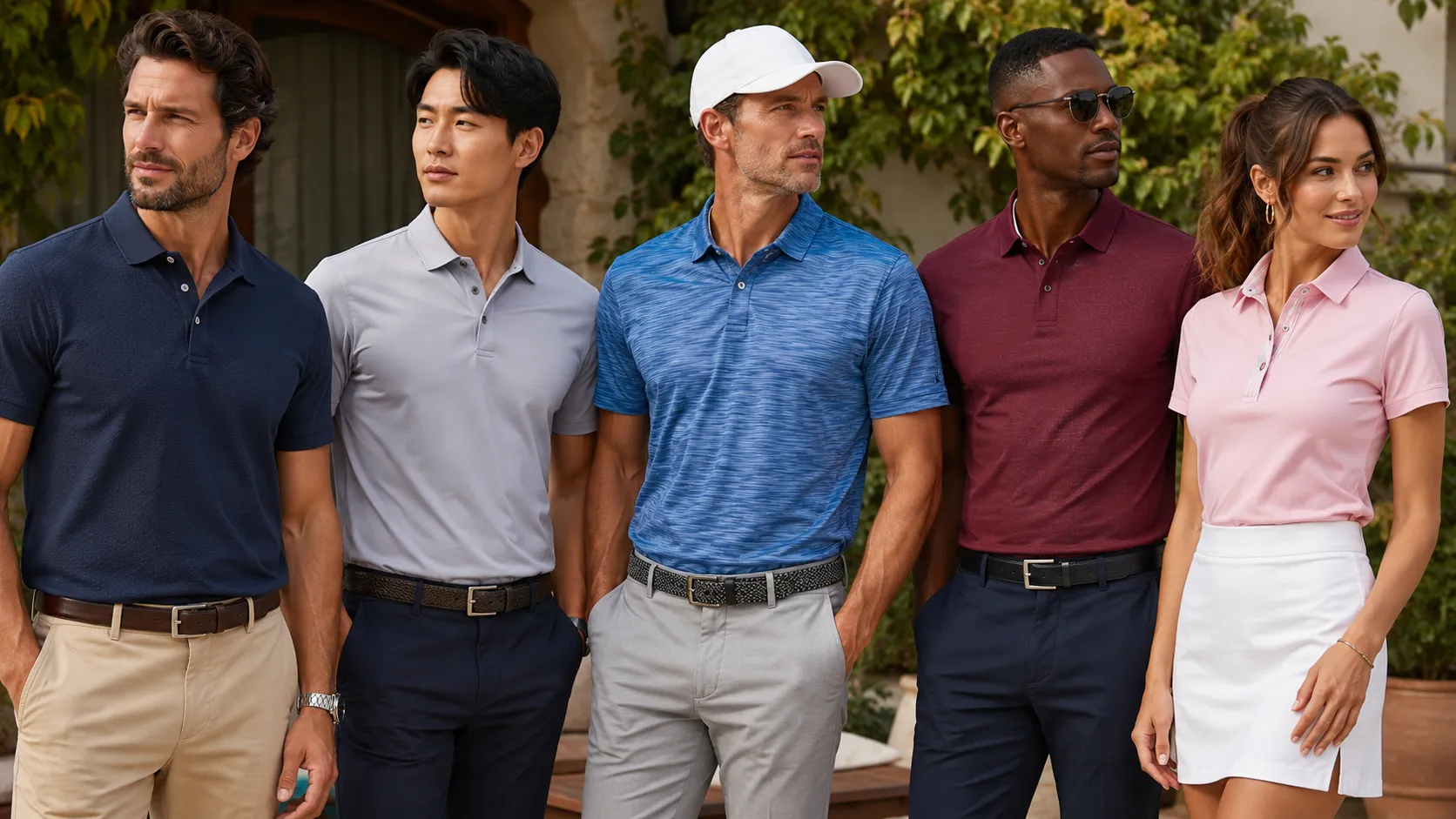
Die wichtigsten Polohemd Arten sind Piqué, Jersey, Interlock, Golf, Fashion, Business, Langarm, Tipped und Polo Dress. Ich wähle nach Stoff, Fit, Zielkunde, Nutzung und Preis.
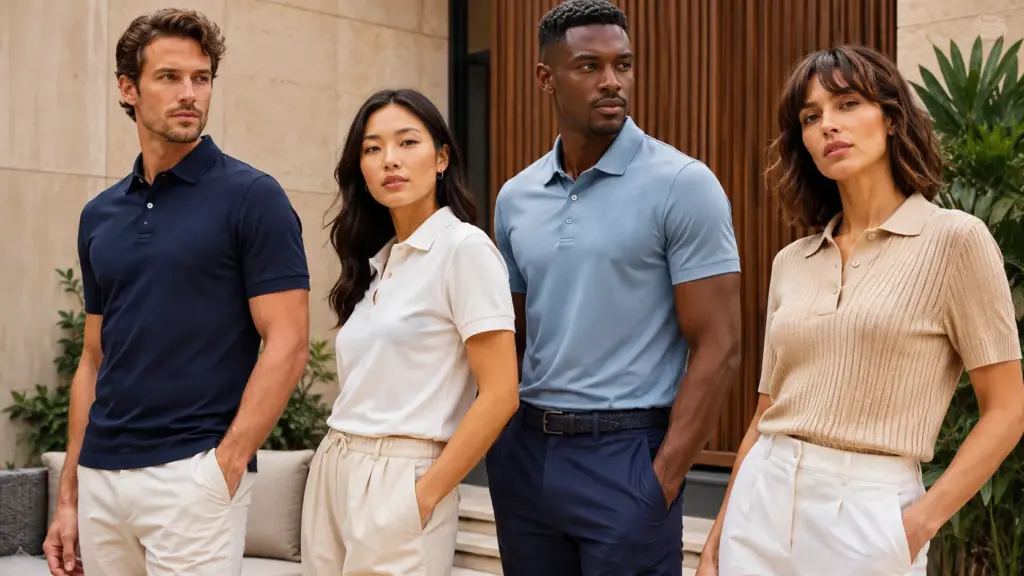
Ich habe in meinen Jahren in der Bekleidungsindustrie viele Poloarten produziert. Im B2B liegt der echte Unterschied nicht nur im Design, sondern bei Stoff, Einlaufen, Kragen, Stickerei und Qualitätskontrolle.
Was gilt als Poloshirt?
Viele Käufer verwenden Bezeichnungen wie Polo-Shirts, Golfshirts und Business-Poloshirts. Diese Bezeichnungen können zu Verwirrung führen, wenn die Produktdetails nicht eindeutig sind.
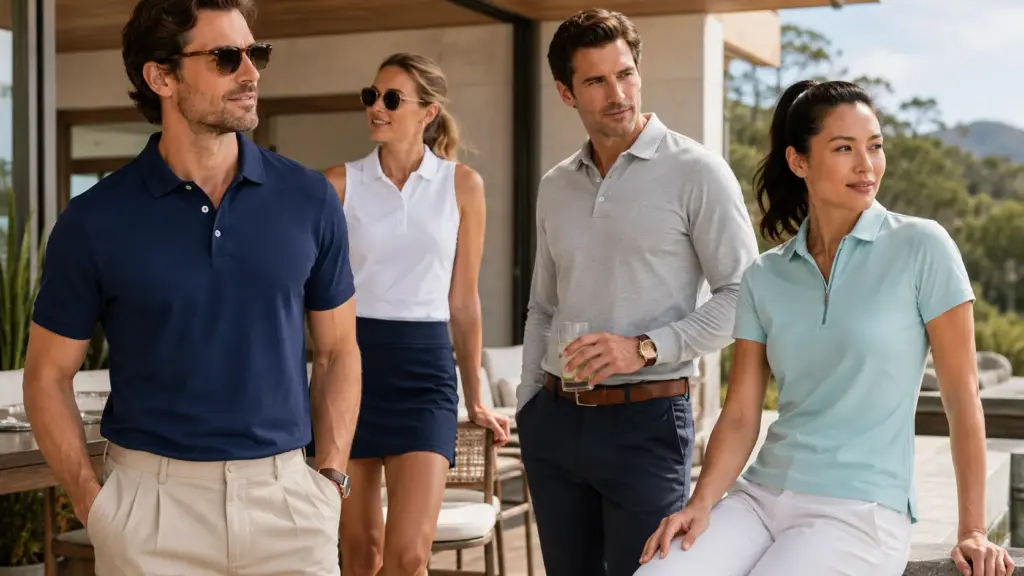
Ein Polohemd ist meist ein gestricktes Oberteil mit Kragen, kurzer Knopfleiste und zwei oder mehr Knöpfen. Die meisten sind kurzärmelig, aber es gibt auch Langarm-, ärmellose, Zip-, Dress-Polo- und Polo-Dress-Varianten.
Aus welchen Grundbestandteilen besteht ein Poloshirt?
Ich erkenne ein Poloshirt meist an Kragen, Knopfleiste, gestricktem Body-Stoff und Saumabschluss. Internationale Käufer suchen auch nach camisa tipo polo, golf shirt oder Business Polo.
Ich definiere ein Polohemd nicht allein über seine Knöpfe. Ein Polohemd mit Rundhalsausschnitt mag zwar den Stoff und die Passform eines Polohemdes übernehmen, aber ich würde es normalerweise als T-Shirt einstufen, da es keinen Kragen hat. Ein Polohemd mit durchgehender Knopfleiste ähnelt eher einem lässigen Strickhemd, da seine Knopfleiste bis zum Saum reicht.
Internationale Käufer verwenden möglicherweise andere Produktbezeichnungen. Ein spanischsprachiger Käufer sucht möglicherweise nach einem camisa tipo polo oder Polo-Kleidung. Andere Käufer verwenden möglicherweise Bezeichnungen wie Polo-Shirt, Golfshirt, Tennisshirt oder Business-Polo. Ich prüfe die Konstruktionsdetails, bevor ich ein Angebot erstelle, da Produktnamen allein nicht aussagekräftig sind.
| Polo-Komponente | Übliche Bauweise | Warum ich das überprüfe |
|---|---|---|
| Kragen | Rippstrick, aus dem gleichen Stoff oder glatt gestrickt | Es bestimmt Form und Aussehen |
| Blende | Zwei, drei oder vier Knöpfe | Es beeinflusst Stil und Produktionskosten |
| Körper | Piqué, Jersey, Interlock oder Funktionsstrick | Es reguliert Komfort und Haltbarkeit. |
| Ärmel | Kurz, lang, ärmellos oder Raglan | Es ändert seine Funktion und Jahreszeit |
| Saum | Gerades, belüftetes oder abfallendes Heck | Es beeinträchtigt Bewegung und Passform. |
| Branding | Stickerei, Druck, Abzeichen oder Transfer | Es beeinflusst die endgültige Markenposition |
Ich bitte stets um ein Referenzmuster, eine Maßtabelle oder ein technisches Datenblatt. Mithilfe dieser Unterlagen vermeide ich Missverständnisse darüber, was der Käufer mit “Polo” meint.”
Aus welchen Hauptmaterialien werden Poloshirts hergestellt?
Stoffbezeichnungen klingen oft einfach, doch jeder Strickstoff hat eine andere Oberfläche, ein anderes Gewicht, eine andere Dehnbarkeit, andere Kosten und ein anderes Waschergebnis. Eine falsche Wahl kann die gesamte Kollektion beeinträchtigen.
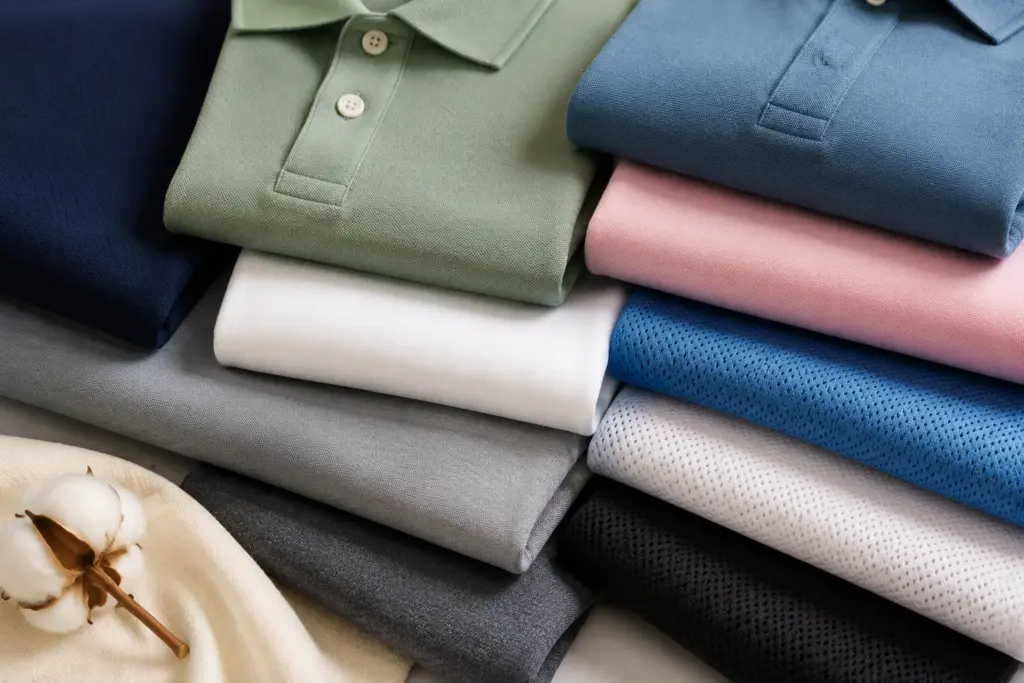
Die häufigsten Polostoffe sind Baumwoll-Piqué, Baumwoll-Jersey, Interlock, Polyester-Mesh, Baumwoll-Polyester-Mischungen und Stretchstoffe. Piqué gibt Struktur, Jersey Weichheit, Performance Knit trocknet schneller.
Was ist ein Piqué Polo?
Ein Piqué Polo nutzt einen strukturierten Strickstoff. Die Oberfläche wirkt oft wie kleine Waben, erhabene Punkte oder feine geometrische Muster und gibt dem Kleidungsstück Körper.
Ich empfehle Baumwoll-Piqué oft für klassische Herrenpolos, Uniformen, Schoolwear, golf-inspirierte Kollektionen und Poloshirts mit Firmenlogo. Kragen und Knopfleiste bleiben stabiler.
Nicht jeder Piqué-Stoff hat dieselbe Qualität. Bei Bulk Orders prüfe ich GSM, Farbechtheit, Einlaufen, Griff und ob der Kragen nach dem Waschen flach bleibt.
Ein Baumwoll-Polyester-Piqué kann Einlaufen reduzieren und Haltbarkeit verbessern. Für Uniformen und Business Polos funktioniert diese Mischung manchmal besser als 100 % Baumwolle.
| Piqué-Typ | Hauptvorteil | Gebräuchliche Verwendung |
|---|---|---|
| 100% Baumwoll-Piqué | Natürliches Handgefühl | Klassische Poloshirts |
| Baumwoll-Polyester-Piqué | Bessere Haltbarkeit | Uniformen und Arbeitskleidung |
| Baumwoll-Elastan-Piqué | Zusätzliche Dehnung | Schmal geschnittene Poloshirts |
| Polyester-Piqué | Schnell trocknend | Sport- und Golfhemden |
| mercerisiertes Baumwollpiqué | Glatte Premium-Oberfläche | Hochwertige Polo-Kleider |
Wenn ein Einkäufer fragt: “Was ist ein Piqué-Poloshirt?”, gebe ich nicht nur eine Stoffbeschreibung. Ich frage auch nach der Zielgruppe, dem Verkaufspreis, dem Klima, der Waschmethode und der erwarteten Bestellmenge.
Was ist der Unterschied zwischen Piqué- und Jersey-Polos?
Viele Käufer vergleichen Piqué und Jersey lediglich nach dem Aussehen. Dies kann zu einer Fehlentscheidung führen, da sich die beiden Stoffe auch bei der Herstellung und im Gebrauch unterschiedlich verhalten.
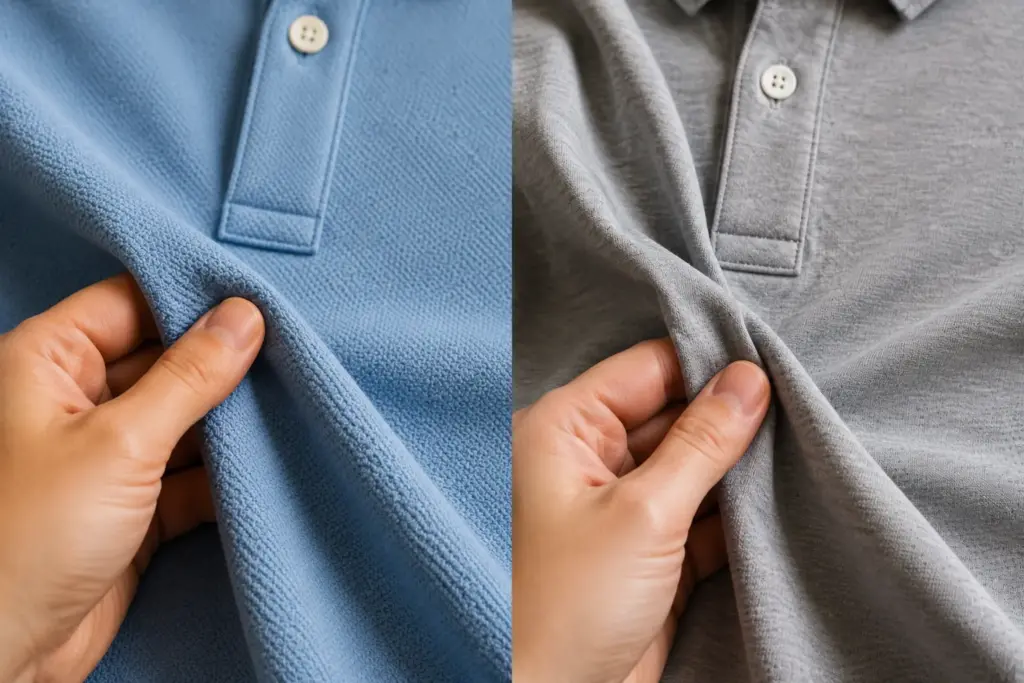
Piqué-Polos haben eine strukturierte Oberfläche, Jersey-Polos eine glatte und weiche. Piqué wirkt klassischer, Jersey lässiger und näher an einem Premium-T-Shirt.
Wie schneiden Piqué und Jersey ab?
Ich bekomme viele Fragen zu Jersey vs Piqué. Meine Antwort hängt vom Verkaufskanal ab: formeller Retail, Uniform, Golf und Firmenkleidung bevorzugen oft Piqué; Casual und Lifestyle eher Jersey.
Jersey hat eine glattere, weichere Oberfläche und fühlt sich ähnlich an wie ein normales T-Shirt. Außerdem fällt er fließender am Körper. Ich verwende Jersey für leichte Sommerpolos, Slim-Fit-Poloshirts, modische Damenpolos und lässige Polo-Shirt-Outfits.
Jersey kann Körperformen deutlicher hervorheben. Dünner Jersey-Stoff kann sich während der Produktion an den Kanten einrollen. Er kann einlaufen oder sich verdrehen, wenn das Stricken und die Veredelung nicht kontrolliert werden. Ich achte daher genau auf Stoffgewicht, Einrollung, Einlaufen und Formbeständigkeit.
Piqué kann auch Probleme bereiten. Ein lockeres Piqué kann leicht Fäden ziehen. Ein minderwertiger Kragen kann sich nach dem Waschen einrollen. Ein schweres Piqué kann sich auf heißen Märkten zu warm anfühlen.
| Merkmal | Piqué-Polo | Jersey-Polo |
|---|---|---|
| Oberfläche | Strukturiert | Glatt |
| Struktur | Fest und stabil | Weich und flexibel |
| Aussehen | Klassisch und traditionell | Lässig und modern |
| Gebräuchliche Verwendung | Uniformen, Golf, Business | Mode und Alltagskleidung |
| Hauptrisiko | Hängenbleiben oder raues Gefühl | Locken oder Schrumpfen |
| Optimale Passform | Klassisch oder regulär | Schlank oder entspannt |
| Druck | Geeignet für einfache Ausdrucke | Geeignet für detailreiche Ausdrucke |
| Stickerei | Normalerweise stabil | Bei leichten Stoffen ist eine Verstärkung erforderlich. |
Je nach Kundenwunsch wähle ich zwischen einem Piqué-Polohemd und einem normalen Jersey-Polohemd. Der Stoffpreis allein ist dabei nicht ausschlaggebend.
Was ist der Unterschied zwischen Interlock- und Piqué-Polos?
Manche Käufer erwarten, dass sich Interlock und Piqué ähnlich anfühlen, weil beide für Premium-Polos genutzt werden. Tatsächlich unterscheiden sich Oberfläche, Gewicht, Fall und Preis stark.
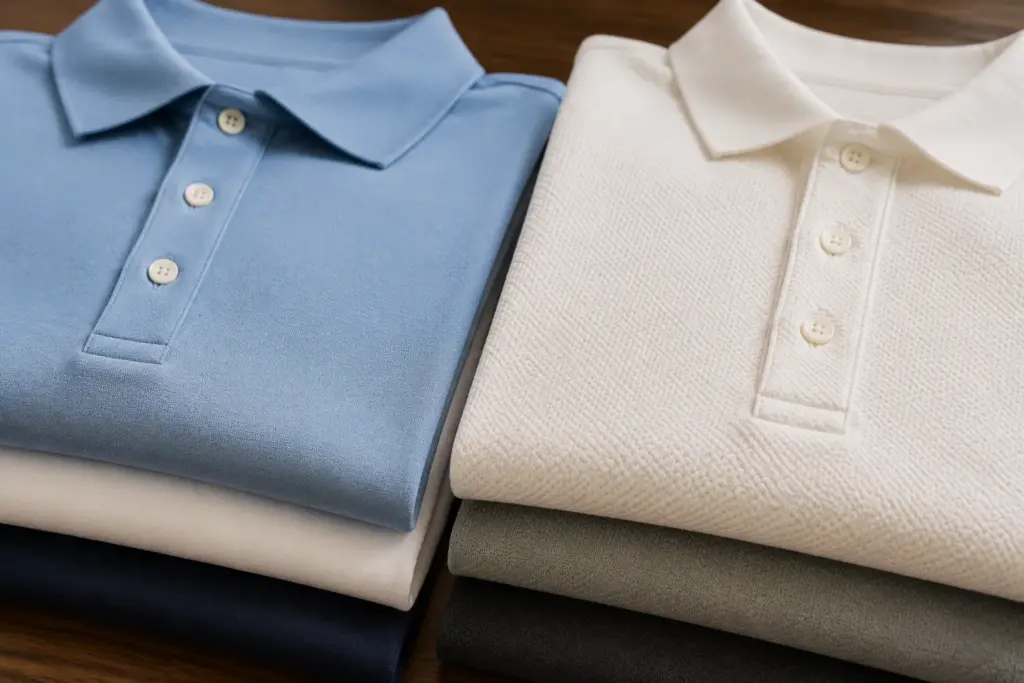
Interlock-Polo-Stoff ist glatt, dicht und stabil, während Piqué strukturiert und traditioneller ist. Interlock passt zu cleanen Dress Polos; Piqué zu klassischen Polos und Uniformen.
Wann sollte ich Interlock-Gewebe verwenden?
Interlock-Gewebe hat eine Doppelstrickstruktur. Es fühlt sich in der Regel dicker, glatter und formstabiler an als Single-Jersey. Beide Seiten des Stoffes können sauber aussehen. Außerdem rollt sich der Stoff beim Zuschneiden und Nähen weniger ein.
Ich nutze Interlock, wenn der Käufer ein gepflegtes Polo mit glatter Oberfläche möchte. Es passt zu Business-Casual, Premium-Fashion und Kollektionen mit feiner Stickerei oder kompaktem Griff.
Interlockgewebe benötigt jedoch in der Regel mehr Garn. Dadurch kann das Stoffgewicht und der Preis steigen. Ein dicht gewebter Interlock kann sich in warmen Klimazonen zu warm anfühlen. Ein minderwertiger Interlock kann zudem nach mehrmaligem Waschen fusseln.
Piqué verleiht Poloshirts einen traditionelleren Look. Es hat in der Regel eine besser sichtbare Textur und ist atmungsaktiver. Außerdem ist es in vielen Stärken und Fasermischungen erhältlich.
| Merkmal | Interlock-Polo | Piqué-Polo |
|---|---|---|
| Oberfläche | Glatt | Strukturiert |
| Strickstruktur | Doppelstrick | Erhabene Strickstruktur |
| Drapierung | Sauber und kontrolliert | Strukturiert |
| Gewicht | Oft mittel bis schwer | Leicht bis schwer |
| Aussehen | Modern und hochwertig | Klassisch und sportlich |
| Gebräuchliche Verwendung | Poloshirts für Business und festliche Anlässe | Golf, Uniform und klassische Poloshirts |
| Hauptrisiko | Hohes Gewicht oder Pilling | Hängenbleiben oder Einrollen des Kragens |
| Kosten | Normalerweise höher | Breites Preisspektrum |
Ich teste den echten Stoff, bevor ich Interlock-vs-Piqué-Bestellungen bestätige. Der Stoffname garantiert weder Einlaufen, Rücksprung, Pilling noch Kragenstabilität.
Welche Polo-Passformen sollte eine Marke anbieten?
Eine große Polo-Linie wirkt attraktiv, aber zu viele ähnliche Fits teilen Verkäufe und erhöhen Lagerbestand. Ich bevorzuge eine klare Range mit Classic Fit, Regular Fit und Slim Fit.
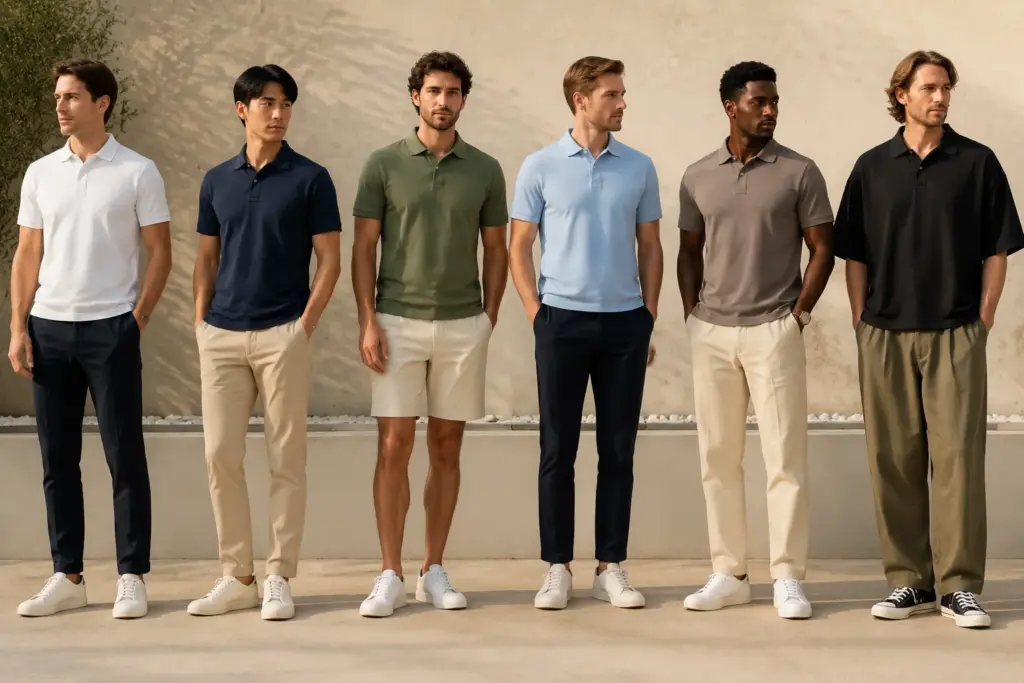
Die wichtigsten Polo-Passformen sind Classic, Regular, Slim, Tailored, Relaxed und Oversized. Ich wähle nach Alter, Körperform, Markt, Saison und Vertriebskanal.
Worin unterscheiden sich klassische, schmal geschnittene und lockere Poloshirts?
Die klassische Passform halte ich für den sichersten Ausgangspunkt. Sie bietet ausreichend Platz im Brust-, Taillen-, Schulter- und Ärmelbereich und eignet sich für eine breite Kundengruppe. Ich empfehle sie häufig für Herrenpoloshirts, Arbeitskleidung, Supermarktkollektionen und wiederkehrende Großhandelsbestellungen.
Ich verwende Slim-Fit-Schnitte, wenn die Marke ein jüngeres oder dynamischeres Image vermitteln möchte. Dabei reduziere ich Brustumfang, Taillenumfang, Ärmelweite und manchmal auch die Länge. Die Bewegungsfreiheit im Schulterbereich bleibt jedoch erhalten. Ein Hemd kann an einem Model zwar attraktiv aussehen, sich im Alltag aber unbequem anfühlen.
Ein taillierter Schnitt liegt zwischen klassisch und schmal. Er formt die Figur, ohne einzuengen. Ich verwende ihn häufig für Business-Poloshirts und hochwertige Freizeitkleidung.
Für meine Modekollektionen verwende ich Poloshirts in lässiger oder Oversize-Passform. Diese Poloshirts zeichnen sich durch überschnittene Schultern, weite Ärmel, kastenförmige Schnitte, große Kragen oder längere Knopfleisten aus. Sie verleihen dem Kleidungsstück eine starke visuelle Identität, die Größentabelle muss jedoch eindeutig sein.
| Polo-Passform | Hauptform | Geeigneter Kunde |
|---|---|---|
| Klassische Passform | Gerade und geräumig | Massenmarkt |
| Normale Passform | Ausgewogene Körperform | Allgemeiner Einzelhandel |
| Schmale Passform | Schmale Brust und Taille | Junger Modemarkt |
| Taillierte Passform | Leichte Körperformung | Business Casual |
| Bequeme Passform | Locker und bequem | Lifestyle-Marken |
| Oversize-Passform | Breit und kastenförmig | Streetwear-Marken |
Ich rate Käufern, vor der Bestellung mehrerer Farben ein Passformmuster zur Genehmigung anzufordern. Ein einzelnes Schnittmuster lässt sich leichter korrigieren als Tausende fertiger Poloshirts.
Welche wichtigsten Polo-Styles gibt es?
Viele Poloshirts basieren auf der gleichen Grundkonstruktion, doch kleine Designänderungen können ihre Marktposition grundlegend verändern. Auch ein unpassendes Detail kann dazu führen, dass das Produkt altmodisch wirkt.
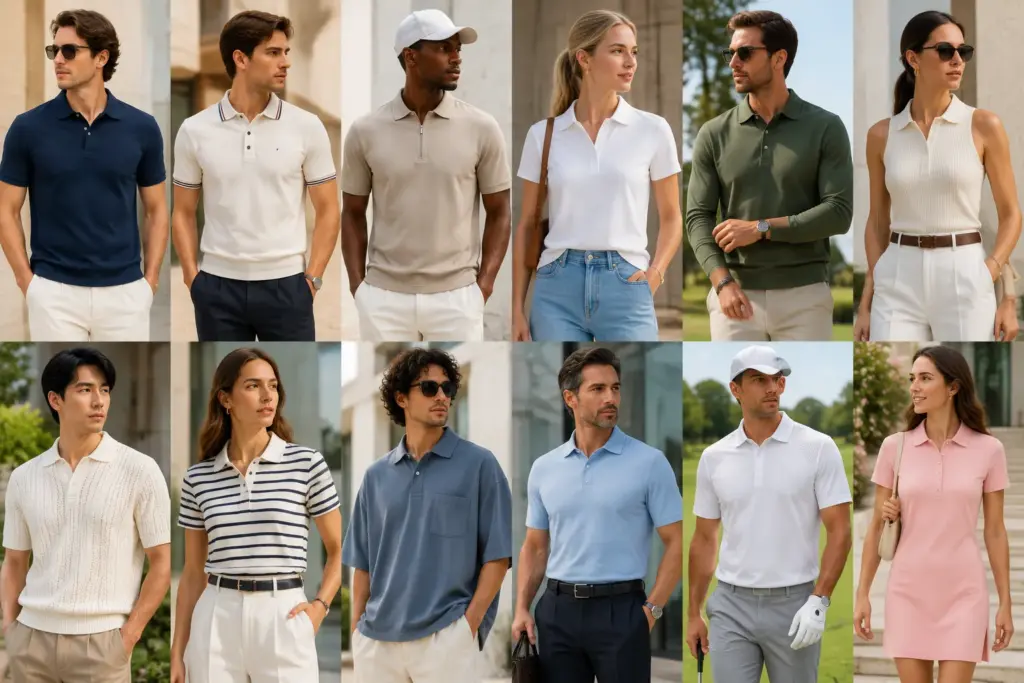
Beliebte Polo-Styles sind Classic, Tipped, Zip, buttonless, Langarm, ärmellos, knitted, printed, oversized, business, golf und fashion. Nicht jeder passt zum gleichen Markt.
Welche Polo-Stile eignen sich für verschiedene Märkte?
Ein klassisches Polohemd hat einen gerippten Kragen, eine kurze Knopfleiste und kurze Ärmel. Ich verwende es für Massenmarktprogramme, Schulkleidung, Uniformen und einfache Herren-Polohemden.
Ein Poloshirt mit kontrastierenden Streifen an Kragen oder Ärmelbündchen verleiht dem Shirt einen sportlichen oder klassischen Look. Ich verwende es häufig für Modemarken, Vereine und Werbeaktionen.
Ein Zip Polo ersetzt die Knopfleiste durch einen Reißverschluss. Es wirkt cleaner und moderner, passend für Interlock, mercerisierte Baumwolle und Premium-Kollektionen.
Ein Polohemd ohne Knöpfe kann mit offenem Kragen, V-Ausschnitt oder Stehkragen erhältlich sein. Es eignet sich gut für Resortmode und lässige Modekollektionen.
Ein langärmeliges Polohemd verlängert die Verkaufssaison. Für kühlere Märkte verwende ich oft schwerere Piqué-, Interlock-, Wollmischungs- oder angeraute Stoffe. Ich kann auch Rippbündchen, kontrastfarbene Kragen und Ärmelstickereien hinzufügen.
| Polo-Stil | Hauptdetails | Geeigneter Markt |
|---|---|---|
| Klassisches Polo | Knopfleiste | Massenmarkt |
| Polo mit Tipps | Kontrastierende Kragenstreifen | Sport und Kulturerbe |
| Polohemd mit Reißverschluss | Frontreißverschluss | Moderne Mode |
| Polohemd ohne Knöpfe | Offener Ausschnitt | Resort und leger |
| Langarm-Polohemd | Ärmel in voller Länge | Herbst und Winter |
| Ärmelloses Polohemd | Offene Arme | Golf und Sommer |
| Gestricktes Polohemd | Pulloverartiges Strickmuster | Premium-Mode |
| Bedrucktes Polohemd | Oberflächenmuster | Lifestyle-Marken |
| Übergroßes Polohemd | Breite Karosserie | Streetwear |
| Business-Polo | Klare, taillierte Form | Unternehmensmarkt |
Den Stil wähle ich erst, nachdem ich den Kunden, den Verkaufspreis, den Stoff und den Liefertermin verstanden habe.
Wie unterscheiden sich Golfshirts von normalen Polos?
Ein Golfshirt kann wie ein normales Polo aussehen, aber der Träger erwartet mehr Bewegung, schnelleres Trocknen und Outdoor-Komfort. Standard-Baumwolle kann nach Schweiß schwer wirken.
Golfshirts nutzen meist leichtes Performance Fabric, Feuchtigkeitskontrolle, Stretch, Quick-Dry-Technologie und Athletic Fit. Normale Polos priorisieren Struktur, Baumwollgriff und Alltag.

Welche Leistungsmerkmale sind bei Golfshirts wichtig?
Ich beginne jedes Golfshirt-Projekt mit einer Bewegungsanalyse. Ein Golfer muss Schultern und Oberkörper drehen können, ohne dass das Shirt verrutscht. Dafür verwende ich Raglanärmel, Stretchgarn, Einsätze unter den Armen, Seitenschlitze oder einen verlängerten Saum. Diese Details verbessern die Bewegungsfreiheit, ohne dass das Shirt locker wirkt.
Ich wähle oft Polyester, recyceltes Polyester, Nylon oder Polyester-Elastan-Mischungen für Polo Golf Shirts. Diese Materialien trocknen schneller als Baumwoll-Piqué und passen besser zu Sport.
Ich verwende gelegentlich eine baumwollreiche Funktionsmischung, wenn der Käufer ein natürlicheres Tragegefühl wünscht. Dennoch teste ich die Trocknungseigenschaften, da Baumwolle Feuchtigkeit speichern kann.
Ich prüfe auch die Stoffoberfläche. Ein feines Netzgewebe kann die Luftzirkulation verbessern, aber ein sehr offenes Netzgewebe kann billig wirken oder die Haut durchscheinen lassen. Ein dichtes Interlock-Gewebe kann hochwertig aussehen, sich aber unter Umständen zu warm anfühlen.
| Golfpolo-Feature | Utilité | Was ich teste |
|---|---|---|
| Feuchtigkeitsmanagement | Leitet Schweiß vom Körper weg | Trocknungszeit und Absorption |
| Strecken | Unterstützt den Golfschwung | Rückstellkraft und Nahtfestigkeit |
| Atmungsaktives Netzgewebe | Gibt Körperwärme ab | Atmungsaktivität und Komfort des Stoffes |
| UV-Schutz | Geeignet für den Einsatz im Freien | Gültige Laborberichte |
| Schnelltrocknende Oberfläche | Reduziert das Nässegefühl | Leistung nach dem Waschen |
| Geruchshemmende Ausrüstung | Unterstützt lange Tragedauer | Oberflächenbeständigkeit |
| Abgerundeter Saum | Hält das Hemd an Ort und Stelle | Körperlänge und Bewegung |
Leistungsversprechen ohne Nachweis akzeptiere ich nicht. Ich verlange aktuelle Prüfberichte, wenn ein Käufer eine bestimmte Funktion benötigt.
Welche Arten von Damenpolos gibt es?
Ein einfaches Herren-Schnittmuster lässt sich nicht ohne Weiteres auf ein Damen-Polohemd übertragen. Eine unvorteilhafte Passform kann zu engen Schultern, einem zu weiten Bund und einem unbequemen Sitz im Brustbereich führen.
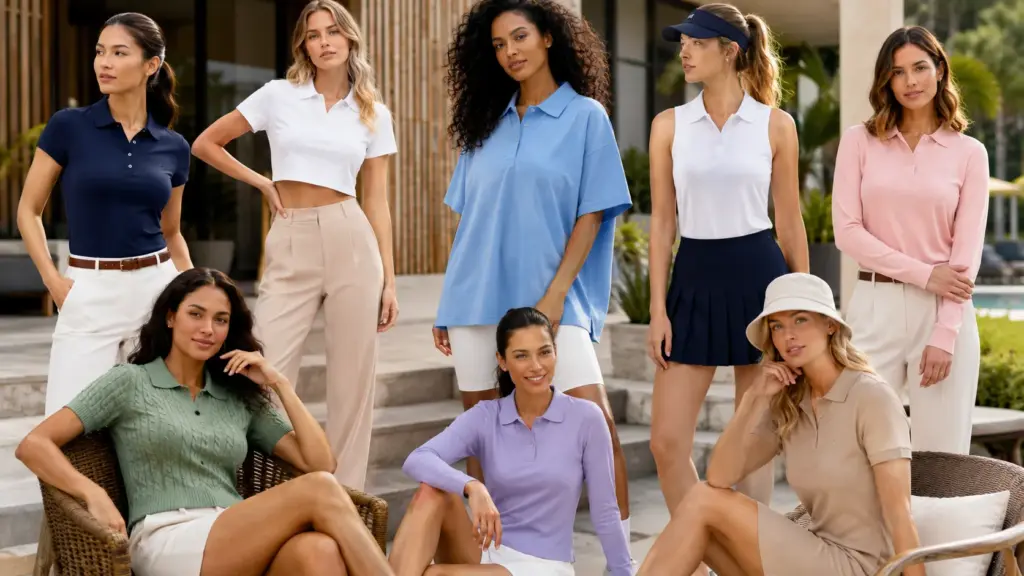
Damenpolos umfassen fitted, cropped, oversized, sleeveless, long-sleeve, performance, knitted und Polo Shirt Dress Styles. Jeder Typ braucht eigene Proportionen und Details.
Wie entwickle ich modische Poloshirts für Damen?
Ich beginne die Entwicklung von Damenpoloshirts mit der Zielgruppe. Ein tailliertes Büropoloshirt erfordert eine andere Schnittführung als ein legeres Freizeitpoloshirt. Ich passe Schulterpartie, Brustumfang, Taille, Hüftumfang, Armausschnitt, Ärmelöffnung und Rumpflänge an.
Ich prüfe außerdem, ob der Kunde das Hemd in die Hose gesteckt oder darüber tragen wird. Davon hängen die Hemdlänge und der Saum ab.
Ich verwende Jersey oder Stretch-Piqué, wenn ich eine figurbetonte Passform benötige. Für ein elegantes Polohemd mit einer klareren Oberfläche greife ich zu Interlock, Strickwaren, mercerisierter Baumwolle, Modalmischungen oder feinem Rippstrick. Für ein kastenförmiges, modisches Polohemd verwende ich mitunter schweren Jersey.
Ich kann außerdem garngefärbte Streifen, Jacquard-Texturen, Drucke, Stickereien, kontrastierende Paspeln, Metallreißverschlüsse, Perlmuttknöpfe und spezielle Waschungen hinzufügen.
Ein Poloshirtkleid streckt die Figur und kann taillierte Details, Seitenschlitze, Gürtel oder ausgestellte Röcke haben. Ein Poloshirtkleid verleiht der Trägerin einen lässigeren Look.
| Damen-Polohemd | Wichtigster Designpunkt | Geeigneter Markt |
|---|---|---|
| Figurbetontes Polohemd | Brust- und Taillenformung | Büro und gepflegte Freizeitkleidung |
| Kurz geschnittenes Polohemd | Kontrollierte Körperlänge | Junge Modekunden |
| Übergroßes Polohemd | Schulter- und Ärmelvolumen | Streetwear |
| Ärmelloses Polohemd | Armlochabdeckung | Sommer und Golf |
| Strick-Polokleid | Fall und Kragenstabilität | Premium-Mode |
| Polohemdkleid | Hüftpassform und Bekleidungsbalance | Freizeitkleider |
| Performance-Polo | Dehnungs- und Feuchtigkeitskontrolle | Golf und Tennis |
Ich erstelle die Schnittmuster für alle gewünschten Größen. Vor der Produktion überprüfe ich außerdem die größte und die kleinste Größe.
Lohnen sich Premium- oder günstige Polos?
Ein niedriges Angebot mag verlockend erscheinen, doch die Endkosten können durch Reklamationen, Verzögerungen, fehlgeschlagene Prüfungen oder mangelhafte Folgeaufträge steigen. Ein hoher Preis ist zudem keine Garantie für Qualität.
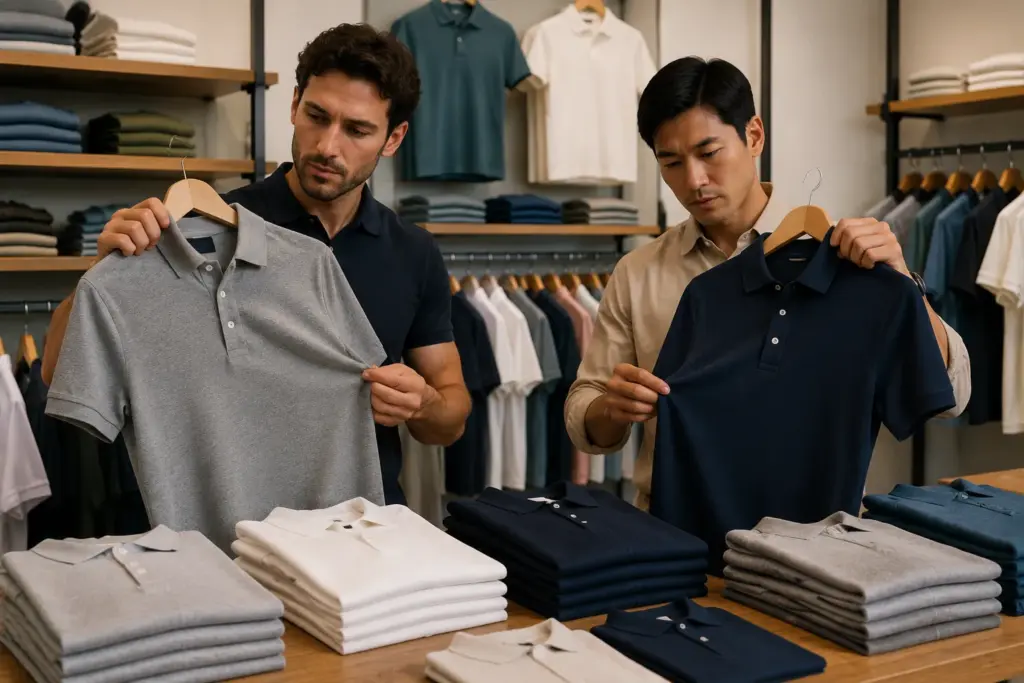
Hochwertige Poloshirts lohnen sich, wenn Material, Verarbeitung, Passform, Tests und Finish einen höheren Verkaufspreis rechtfertigen. Preisgünstige Poloshirts bieten ein besseres Preis-Leistungs-Verhältnis, wenn das Design schlicht, die Produktionsmenge ausreichend und die Qualität vom Hersteller gleichbleibend hoch ist.
Was beeinflusst den Preis von Poloshirts?
Der Stoff ist für mich einer der größten Preisfaktoren. Feine Baumwolle, merzerisierte Baumwolle, langstapelige Baumwolle, Recyclingfasern, Spezialgarne und funktionelle Ausrüstungen können die Kosten erhöhen. Auch das Stoffgewicht spielt eine Rolle, da für ein schwereres Hemd mehr Garn benötigt wird.
Ich berechne auch die Kosten für Kragen, Manschetten, Knöpfe, Stickereien, Drucke, Etiketten, Verpackung und Tests. Ein mehrfarbig gesticktes Logo kann teurer sein als ein einfacher Brustdruck. Für einen individuell gefertigten Jacquard-Kragen kann eine höhere Mindestbestellmenge erforderlich sein.
Preiswerte Poloshirts bieten ein gutes Preis-Leistungs-Verhältnis, wenn ich Standardstoffe, eine einfache Verarbeitung, gängige Farben und effiziente Bestellmengen verwende. Hochwertige Poloshirts benötigen mehr als nur teures Material. Sie brauchen formstabile Passform, gleichmäßige Nähte, saubere Kragen, hohe Farbechtheit, ein angenehmes Tragegefühl und eine einheitliche Verarbeitung.
| Preisfaktor | Kostengünstiger Ansatz | Premium-Ansatz |
|---|---|---|
| Stoff | Standardbaumwolle oder Mischgewebe | Feine Baumwolle oder individuelle Mischung |
| Kragen | Einfacher Rippkragen | Technischer oder modischer Kragen |
| Schaltflächen | Standardkunststoff | Maßgefertigt, im Muschelstil oder aus Metall |
| Branding | Einfacher Druck oder Stickerei | Detaillierte Stickerei oder Abzeichen |
| Fit | Standardmusterblock | Maßgeschneidertes Muster |
| Tests | Grundlegende erforderliche Tests | Umfassendere Leistungstests |
| Verpackung | Standard-Polybeutel | Kundenspezifische Einzelhandelsverpackung |
| Qualitätskontrolle | Hauptproduktionskontrollen | Weitere Inspektionsstufen |
Ich empfehle Käufern, Muster mit identischen Spezifikationen zu vergleichen. Ich vergleiche beispielsweise ein Polohemd aus 180 g/m² Baumwoll-Polyester-Mischgewebe nicht mit einem Polohemd aus 240 g/m² mercerisierter Baumwolle nur anhand des Stückpreises.
Wie sourct man Polos mit Firmenlogo?
Poloshirts mit individuellem Logo können das Firmenimage stärken, doch mangelhafte Stickerei, Farbstabilität und Lieferverzögerungen können der Kampagne schaden. Ich minimiere diese Risiken vor der Massenproduktion.
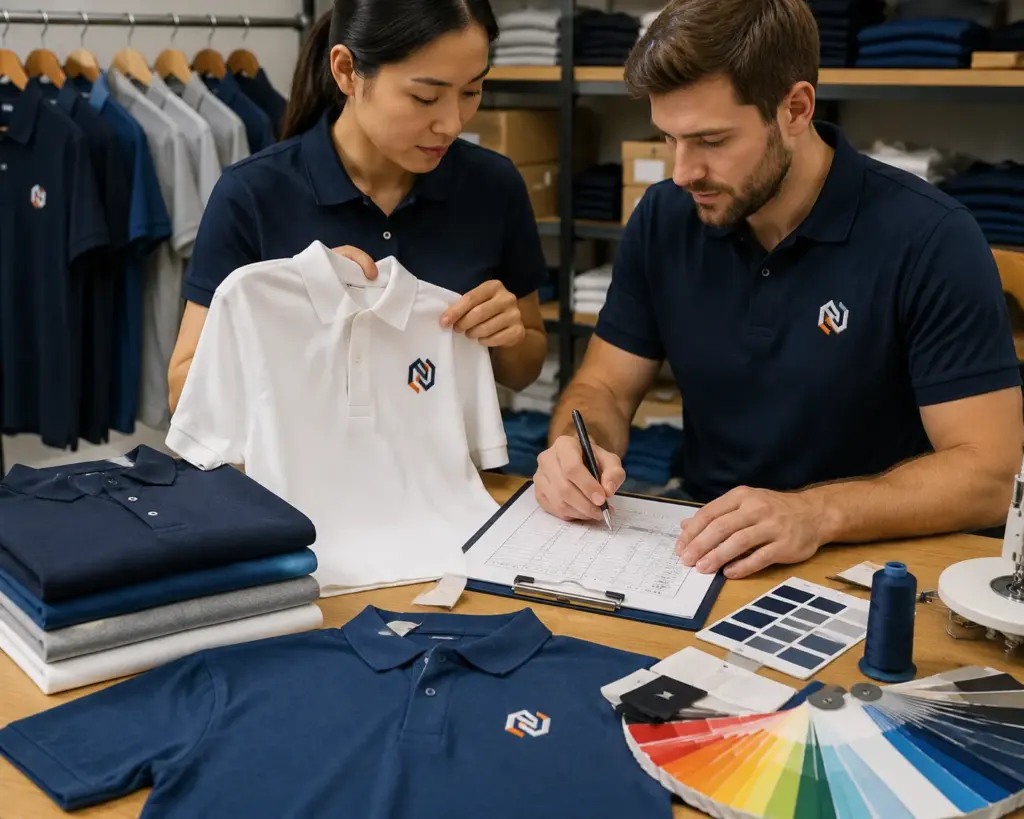
Für Poloshirts mit Firmenlogo bestätige ich Stoff, Fit, Logo-Methode, Farbstandard, Größenlauf, Tests, Verpackung, Liefertermin und Prüfplan. Muster werden vor der Bulk Order freigegeben.
Was sollte meine B2B-Polo-Beschaffungscheckliste beinhalten?
Zuerst frage ich, wo das Polohemd eingesetzt werden soll. Ein Messe-Polohemd muss gepflegt aussehen und zuverlässig sein. Ein Lager-Polohemd muss strapazierfähig und pflegeleicht sein. Ein Golf-Polohemd muss dehnbar und schnelltrocknend sein. Ein Polohemd für den Einzelhandel braucht aussagekräftigere Designdetails und eine hochwertige Stoffqualität.
Anschließend wähle ich die passende Veredelungsmethode. Stickerei verleiht einen traditionellen und langlebigen Look. Siebdruck eignet sich für größere Motive. Thermotransferdruck ermöglicht feine Details und kleinere Auflagen. Silikonabzeichen, gewebte Aufnäher und Chenillestickerei erzeugen einen modischen Effekt.
Ich teste jede Branding-Methode an dem tatsächlichen Stoff, da das Ergebnis je nach Textur und Dehnbarkeit variieren kann.
Ich überprüfe auch Zertifikate und Prüfberichte. Dabei achte ich auf den Namen des Lieferanten, die Produktbeschreibung, die Prüfnorm, das Prüfdatum und die Materialzusammensetzung. Ein Zertifikat allein aufgrund eines Laborlogos akzeptiere ich nicht.
| Beschaffungsphase | Was ich bestätige | Hauptrisiko vermieden |
|---|---|---|
| Produktübersicht | Verwendung, Markt, Preis und Menge | Falsche Produktrichtung |
| Stoffzulassung | Gewicht, Farbe, Haptik und Funktion | Stoffaustausch |
| Passformprobe | Messungen und Bewegung | Rücksendungen und Beschwerden |
| Logo-Beispiel | Position, Größe, Farbe und Methode | Markenfehler |
| Vorserienmuster | Fertigstellung der Endkonstruktion | Großes Missverständnis |
| Inline-Inspektion | Nähen und Maße | Wiederholte Mängel |
| Endkontrolle | Menge, Qualität und Verpackung | Versand fehlerhafter Waren |
| Logistikprüfung | Kartons, Dokumente und Buchung | Die Verkaufssaison verpassen |
Bei Truekung arbeite ich mit Einkäufern an OEM- und ODM-Polo-Programmen. Unsere Fabrik beschäftigt über 200 Mitarbeiter. Unser Team verfügt über 20 Jahre Erfahrung in der Bekleidungsproduktion und im Export.
Ich unterstütze die Stoffbeschaffung, Schnittmusterentwicklung, Mustererstellung, Logoanbringung, Qualitätskontrolle, Verpackung und Versandplanung. Außerdem sorge ich für eine direkte Kommunikation und melde Probleme, bevor es zu Lieferverzögerungen kommt.
Fazit
Ich wähle Poloshirts nach Stoff, Fit, Funktion, Markt und Preis. Danach kontrolliere ich Sampling, Testing, Produktion und Lieferung, um das Geschäft des Käufers zu schützen.
Ansichten: 162